“That was the best sleep I’ve ever had”: Sam’s bone marrow donation experience
Sam was finishing his workday when his phone rang.
A week earlier, he’d tried to donate blood and been turned away, they were fully booked. He hadn’t followed it up. Life moved on.
Now someone from the registry was calling to say he could be a match for a patient with blood cancer.
There was just one problem.
“I’ve never donated blood,” he said. “I’ve never done a swab. I’ve never done anything.”
It took a second phone call, and a conversation with his dad, to piece it together.
A few years earlier, Sam had gone to a community donor drive at a synagogue. Someone had asked if he could spare a few minutes to do a cheek swab. He went with his siblings and didn’t think about it again.
“I honestly didn’t remember it,” he says. “At the time, it was just something you do. Someone needs help, you show up.”
Two years later, that decision came back.
From a quick swab to a 100% match
Sam, 23, works full-time in tech and is building his own app on the side.
When the call came, there was no pressure.
“They made it really clear; this is completely up to you,” he says. “There was zero push.”
The first step was a blood test to confirm whether he was actually a match. He was told it could take months to hear anything back.
It took about two weeks.
“They called me late in the afternoon,” he says. “I still remember where I was sitting.”
He was a 100% match.
“I was like, I’m in. If I can help someone, why not?”
Hear Sam tell this story in his own words
A different kind of donation
Most people who donate blood stem cells do it through a process similar to giving plasma, sitting in a chair while cells are collected from the bloodstream.
Sam’s case was different.
About 90% of donations happen that first way, but Sam would be one of the smaller number of donations where stem cells are collected directly from bone marrow, through a procedure under general anaesthetic.
“It’s one of those things where you hear the term and you don’t really know what it involves,” he says.
Interestingly, he chose not to look it up beforehand.
“I didn’t Google it once,” he admits. “Not because I was scared. I just figured it’s for a good reason. Sometimes it’s better not to overthink it.”
Instead, he asked questions along the way, checking everything with medical staff and donor coordinators.
“There were no barriers. If anything, they encouraged me to ask more.”
What donation day actually looked like
In the weeks leading up to donation, Sam went through routine checks to make sure he was fit.
The procedure itself was scheduled about two months after his first call.
On the day, he arrived at hospital early.
“I had to be there at 7am. Within about 10 minutes I was in a gown, ready to go,” he says.
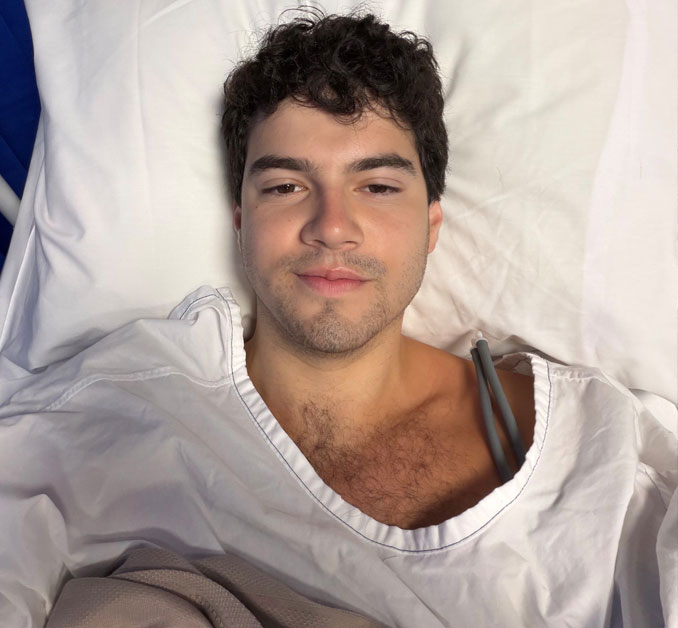
The procedure took around an hour and a half under general anaesthetic. Doctors collected stem cells directly from his pelvic bone using needles, there were no incisions or stitches.
When he woke up, his reaction was immediate.
“I said to the nurse, that was the best sleep I’ve ever had.”
By mid-afternoon, he was discharged and heading home.
Recovery: manageable, not extreme
Because bone marrow donation is a surgical procedure, recovery is different to the more common method, but not as intense as many people expect.
“There was some soreness for a couple of weeks,” Sam says. “Mostly around the lower back, a bit of bruising, a bit of discomfort.”
He managed it with standard pain relief and worked from home while he recovered.
Within three weeks, he was back playing sport.
“I think people imagine it being much more intense than it actually is,” he says. “It wasn’t nothing — but it was very manageable.”
The part you don't see
Like all donors, Sam doesn’t know who received his cells.
He asked out of curiosity but understood why that information isn’t shared.
Still, the significance of the moment isn’t lost on him.
“This is someone’s last treatment option,” he says. “It’s life or death.”
A five-minute decision that stayed with him
For Sam, the most surprising part isn’t the procedure but how it started.
Not with a big decision. Not with a long conversation.
Just a quick swab at a community event he barely remembers attending.
“You really never know,” he says. “You might sign up thinking you’re helping someone you know and end up helping someone completely different, somewhere else.”
His advice is simple: “It takes five minutes. Do it with your friends. It could literally be the difference between life and death for someone.”