Launching our Reflect Reconciliation Action Plan
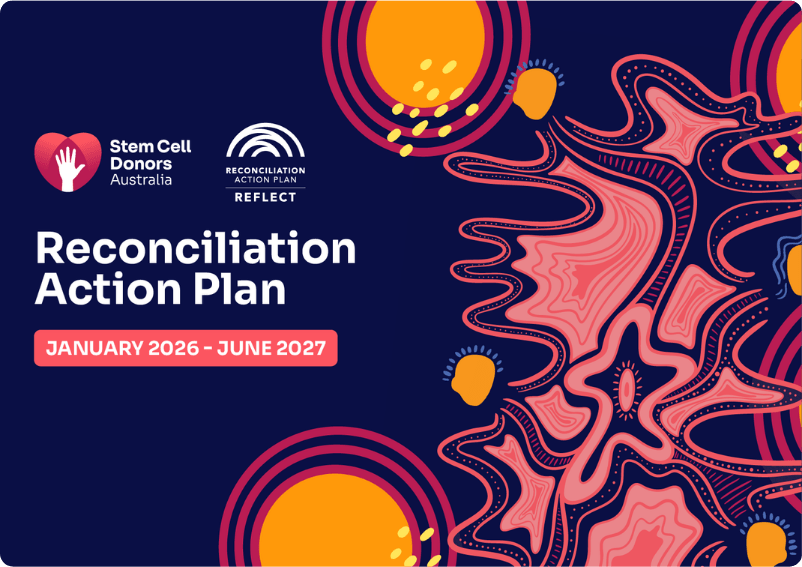
We’re proud to share that Stem Cell Donors Australia’s Reflect Reconciliation Action Plan (RAP) has now been formally endorsed by Reconciliation Australia.
This marks an important step for our organisation. More importantly, it marks a commitment to listen, learn and work differently so we can play our part in reconciliation in a way that is genuine, informed and grounded in our purpose.
Why reconciliation matters to our work
Our role is to give every patient the best possible chance of life by connecting them with a suitable stem cell donor.
But we know that chance is not equal.
Patients with Aboriginal and Torres Strait Islander heritage are significantly less likely to find a fully matched donor through the Australian registry than those of European heritage. This is not because people don’t care or want to help. It reflects deeper issues such as barriers to access, gaps in data, and long standing experiences of health systems that have not always earned trust.
As the national registry of volunteer stem cell donors, we have a responsibility to understand these realities and respond to them. Reconciliation matters to our work because building a donor pool that truly reflects Australia requires trust, cultural understanding and partnership. Without that, inequity in access to life saving treatment will continue.
What a Reflect RAP means
For Stem Cell Donors Australia, a Reflect RAP is about understanding how reconciliation is directly connected to stem cell donation, transplantation and patient outcomes.
It means taking the time to learn what influences people’s decisions to join the donor registry, particularly Aboriginal and Torres Strait Islander Peoples, and recognising that culture, history and lived experience all shape whether donation feels safe, appropriate and meaningful.
Through this Reflect RAP, we are focused on:
- building cultural knowledge and confidence so our staff, materials and processes support informed, respectful decision making about stem cell donation
- strengthening partnerships with Aboriginal and Torres Strait Islander organisations and health services so engagement is led through collaboration, not assumption
- improving how we collect, interpret and use data so the donor pool is shaped by real patient and community needs
- embedding these learnings into everyday practice, from donor recruitment and communications through to governance and leadership
This RAP recognises that recruiting more donors alone is not enough. We need to understand the people behind the numbers, and work together to build a registry that offers better opportunities for every patient whose life depends on finding a match.
Our reconciliation journey so far
Our reconciliation journey began with honest reflection on the role we play in health equity, and the reality that Aboriginal and Torres Strait Islander patients are less likely to find a suitable stem cell donor. From the outset, we understood that meaningful change would require more than awareness or intention. It would require listening, learning and partnership.
To support this, we commissioned research with Aboriginal and Torres Strait Islander Peoples aged 18–35 to better understand awareness, motivations and barriers to joining the donor registry. This work highlighted the importance of culturally grounded information, trusted pathways and community connection.
These insights have been strengthened through collaboration with Aboriginal Health Units in hospitals, NACCHO, ACCHOs across New South Wales and Queensland, and leading Indigenous health researchers. Internally, this learning has been supported by staff education and the establishment of a Reconciliation Working Group to provide governance and accountability. Together, these steps have shaped our Reflect RAP and continue to inform how we move forward.
Artwork and symbolism
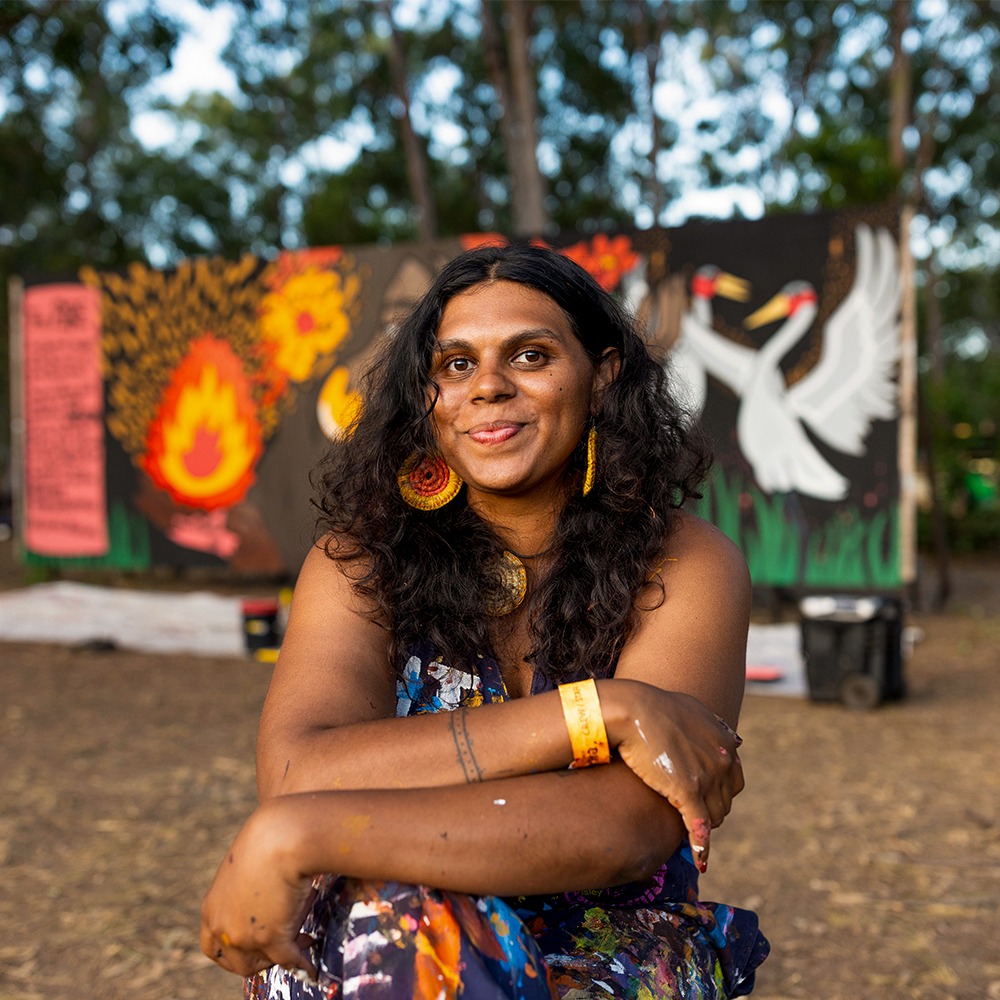
The artwork featured in our RAP was created by Molly Hunt, a Balanggarra and Yolngu artist.
Molly describes the piece as an abstract portrayal of the invisible ties that bind us, reflecting the movement of bloodlines and lifelines between donor and recipient. The flowing lines and interconnected forms speak to generosity, connection and the idea that one life can carry another forward.
This symbolism resonates deeply with our work. Stem cell donation is never a solo act. It is collective, relational and sustained by community. We’re honoured to feature Molly’s artwork as part of our RAP and grateful for the care, meaning and insight it brings to our reconciliation journey.
Looking ahead
Our Reflect RAP runs from January 2026 to June 2027. During this time, we will continue building relationships, strengthening cultural understanding and embedding reconciliation into how we work as an organisation.
Reconciliation is not a destination. It is ongoing work that requires honesty, humility and shared responsibility. We are committed to carrying this work forward with care, and to learning alongside the communities we exist to serve.
We invite our partners, supporters and community to read our Reflect RAP and to walk with us as we continue this journey.