Episode 1: Ollie’s transplant journey
In our first episode, we meet Ollie, a 29-year-old who had just started a new life on the Gold Coast when everything changed. After weeks of unexplained fatigue, dizziness, and bruising, Ollie was diagnosed with acute myeloid leukemia (AML). It was a moment that turned her world upside down.
In this honest and deeply personal conversation, Ollie shares what it felt like to receive that phone call, her experience navigating chemotherapy and a stem cell transplant, and the role a complete stranger played in saving her life. She also reflects on recovery, resilience, and what matters most now.
This is a story about strength and hope — and a powerful reminder of the life-saving impact of stem cell donors.
Listen now and discover how one decision to register can change someone’s future forever.
Listen now:
 Listen on Spotify
 Listen on Apple Podcasts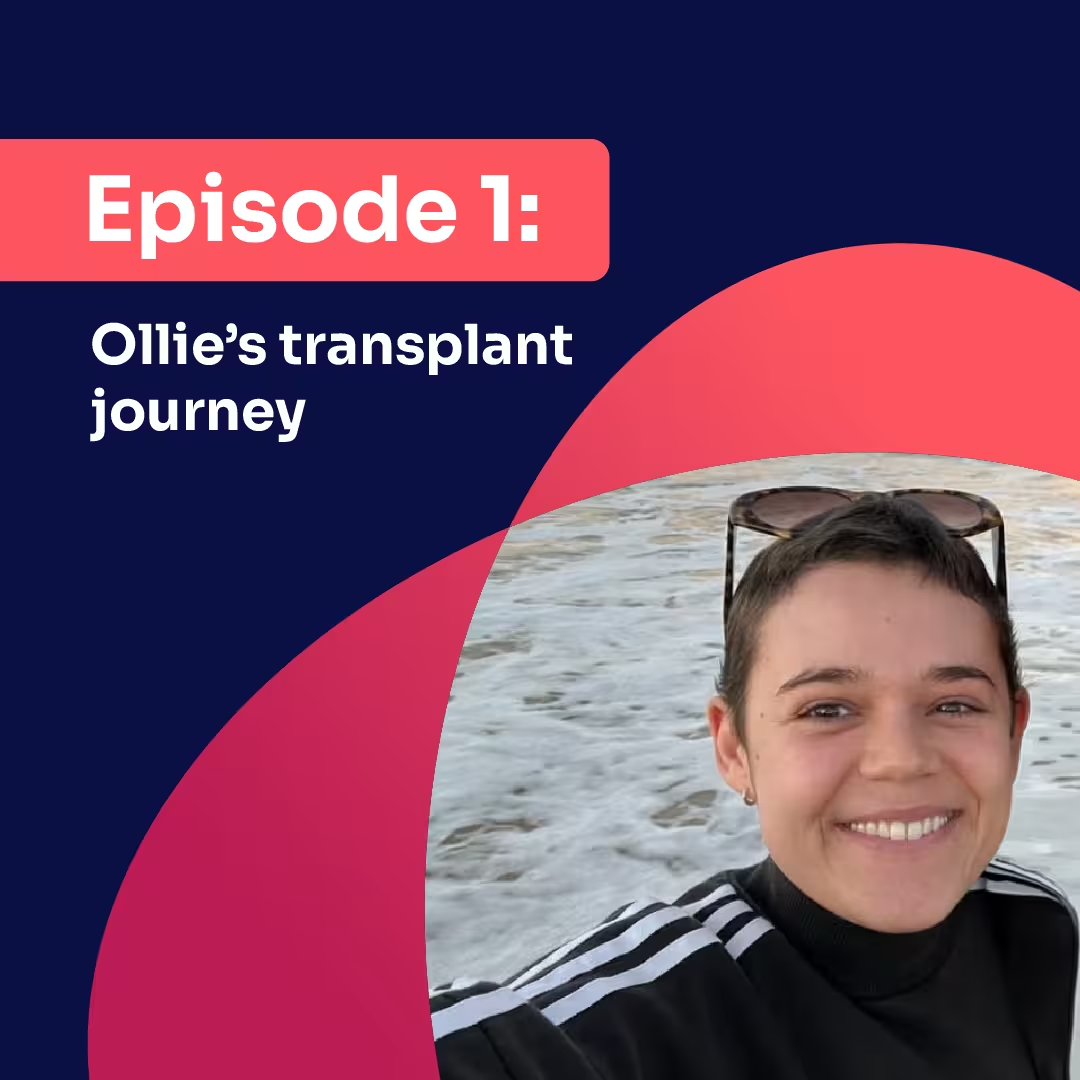
[00:00:02] Kelly: Welcome to the Stem Cell Donors Australia podcast.
[00:00:12] Kelly: Hi, and thanks for tuning in to the Stem Cell Donors Australia podcast. My name’s Kelly. I run our social media channels and have the honour of speaking with our incredible donors and stem cell recipients. Each month, we’ll share real stories from donors, patients, and experts to give you an honest look at the stem cell donation journey, the challenges, the surprises, and the people whose lives are changed along the way.
[00:00:36] Kelly: In our first episode, we hear from Ollie, a 29-year-old from the Gold Coast who was diagnosed with acute myeloid leukemia just months after moving cities. She takes us through the shock of her diagnosis, what it was like preparing for a stem cell donation, and how she’s now looking forward to the future.
[00:00:54] Kelly: Welcome everyone. We’ve got Ollie here today in the driver’s seat for a Stem Cell Donors Australia podcast. Ollie is a stem cell recipient. Welcome Ollie. Tell us a little bit about yourself. Where are you from?
[00:01:09] Ollie: So I’m from, I’m originally from Sydney, Australia, but I moved to the Gold Coast last March and I’m 29 years old. And I was diagnosed with AML, acute myeloid leukemia, back in September last year. So it’s been a pretty crazy 10, 11 months now, almost coming on a year.
[00:01:37] Kelly: Yeah, wow, a year. So nearly a year from diagnosis, not a year from transplant.
[00:01:43] Ollie: Yeah, exactly.
[00:01:45] Kelly: So we’ll start just from the beginning. Tell us what your life was like before the diagnosis. What did a day look like?
[00:01:53] Ollie: So for me, I’ve always kind of, since I started working, I’ve always worked full-time pretty much. And my partner and I, like I said, we moved up to the Gold Coast and we kind of came up here on a whim. We didn’t have anything set up, no accommodation set up, no jobs lined up. We just came up here and kind of started from scratch. And we finally got into our groove, found jobs, started like establishing ourselves in our workplaces and then got the diagnosis. And so it’s pretty crazy. But we, I live quite a simple life, but I’m very big on my health. I love cooking. So I’m very like conscious with food I eat and all of that. And then got the diagnosis and everything kind of changed from there.
[00:02:45] Kelly: So what was the driving force from moving to Sydney to Brisbane out on a whim?
[00:02:51] Ollie: Well, my partner and I, we both worked for the same company and we both got made redundant at the same time. And so for us, we were kind of just looked at each other and we’re like, This is kind of just a sign. Like we always wanted to move up to Queensland at some point. And we were planning to, once our lease ended in Sydney, which wasn’t until November, and we were like, look, let’s just pay out the rest of our lease and let’s just go.
[00:03:20] Kelly: Nice adventure.
[00:03:22] Ollie: Yeah, and neither of us have ever done anything like that. We’ve always said we’ll always live in Sydney, we’ll never leave, and then yeah, we just kind of had a change of heart and got up and left.
[00:03:34] Kelly: So what was the first job you guys tried to kind of land with?
[00:03:38] Ollie: So I was looking for work. So when I was in Sydney, I was an operations coordinator for a warehouse and I was looking for similar work within that field. But yeah, I found it really tough finding something. And so I had, I’ve got management experience with cafes as well. And so I had a lot of barista experience. And so I just thought like there’s plenty of cafes up here.
[00:04:05] Kelly: Yeah.
[00:04:07] Ollie: I’ll just see if I can get a barista job. And I found a really cool place, which I’m still at now, that does specialty coffee. And so yeah, I’ve been working with them ever since.
[00:04:18] Kelly: So yeah, tell me about any symptoms, like what led you to go to the doctor or how did this.
[00:04:25] Ollie: So I kind of started feeling, I think the first symptom I started to feel was fatigue, like just unexplained fatigue. No matter how much sleep I got, I’d wake up just so exhausted. And then I started to experience what I thought was vertigo. So I would get really dizzy, especially right before I went to bed, like if I’d lay my head down on the pillow, I might, like the room would just start spinning. And then I kind of started experiencing hearing loss. And so I’d lose, I’d be at work and my left ear would stop working. And I’d be like, oh gosh, I can’t hear. And then I had the unexplained bruising as well, which just wasn’t going away. And then the last symptom was loss of appetite. And I just started losing weight really quickly. And I was like, oh, I should probably go to the doctor.
[00:05:19] Kelly: Yeah. How long was those symptoms lasting for?
[00:05:21] Ollie: Now when I think back to it, I probably had symptoms for three to four weeks before I even went in to go and get checked. I just like, I never would have thought it would be what it was. I thought it was going to be like anemia or something like that.
[00:05:38] Kelly: I mean, I’m glad it wasn’t actually the first thing that you think about. Sometimes it is for other people. get quite scared. So did it end up being a blood test? Did the doctor was, with the symptoms, was the doctor like, okay, yeah, blood test straight away.
[00:05:51] Ollie: Yeah, so the doctor was like, let’s do a blood test. Because she also like looked at my body and she probably looked at my legs and saw the bruising too. But yeah, she suggested a blood test. So I did that. And it was like a, it was a Wednesday afternoon. And then, I got the call Thursday morning.
[00:06:10] Kelly: Yeah, they’re pretty quick, Yeah. And they called you at work.
[00:06:13] Ollie: Yeah, so I was about to clock on, like literally about to step into the store and… sign on. And I got a call from the doctor and she was like, look, I wouldn’t usually give you this information over the phone, but you have leukemia and you need to go to the hospital right now. And she had already called the hospital and set up like all of that for me. So I was just like to work, I gotta go. And yeah, I called my partner and he came and met me and then his dad came and drove us to the hospital, which was really good.
[00:06:44] Kelly: Yeah, that’s nice. Were you able to process anything at the time? What was going through your head?
[00:06:50] Ollie: Well, I think the first initial feeling, I was just shocked. Like, once she said leukemia, I was like speechless. And then it kind of hit me and I was a little bit emotional, you know. But yeah, from that point, and especially once I got to the hospital and they’re explaining it, It was overwhelming and I was still a little bit upset, especially having to go through, being told that I’d have to go through chemo and all of that. But once it kind of settled down, I was like, let’s just do it. Like there’s nothing, what else am I supposed to do?
[00:07:27] Kelly: Kind of be in an acceptance phase.
[00:07:29] Ollie: Yeah, exactly. And like I’m quite a positive person and I try to have as positive as an outlook on life as I can. And I think that was really important for me going. like going through this as well. It’s just to have that positive mindset.
[00:07:46] Kelly: Absolutely. And when did they, did they try some treatment before advising you needed a stem cell transplant?
[00:07:54] Ollie: So I did my first round of chemo, which it’s called 7 plus 3. And it’s basically you’re hooked up to the chemo 24 7. So for a week, nonstop. And they did that. And I did go into remission after that, but I think the mutations that I had were, like, I don’t think they’re really curable unless you get the transplant. So I was told maybe a month or two after starting treatment that I would need the bone marrow transplant.
[00:08:29] Kelly: Right. So they could kind of tell from the type of cancer that you had that the treatment was not going to work.
[00:08:34] Ollie: Yeah. So I ended up doing, yeah, that first round, the seven plus three. And then I had to do 3 rounds of consolidation chemo until they found my donor. And then luckily they were able to find it really quickly.
[00:08:47] Kelly: And Oh, that is lucky.
[00:08:48] Ollie: Yeah.
[00:08:49] Kelly: What’s consolidation chemo?
[00:08:51] Ollie: I think it’s almost like maintenance chemo, like just to keep anything from coming back, but I’m not 100% sure.
[00:09:00] Kelly: Fair enough. And so when they described to you how the transplant would go, what did they say?
[00:09:07] Ollie: When I had the first initial call with my BMT doctor, who is actually based in Brisbane, it was pretty confronting because obviously they have to lay everything on the plate for you. They can’t give you bits and bobs of risks and everything. So it was pretty confronting, but I knew it was what I needed to do anyway. So we just kind of went through it. But it was very, very confronting.
[00:09:36] Kelly: Was it kind of like, this is your last? resort, like you don’t have another option.
[00:09:41] Ollie: It wasn’t really said like that, but it was kind of like, it was almost implied, like your survival rate is nowhere near as much as if you get it.
[00:09:54] Kelly: And for those listening, BMT is a bone marrow transplant. We usually refer to it as a stem cell transplant, just because, only because bone marrow has such like a negative connotation these days with a big needle in the hip. That’s what we’re referring to, bone marrow transplant. stem cell transplant, same thing.
[00:10:11] Kelly: And so if you were to describe to someone who’d had no idea what a stem cell transplant was and how it would save your life, how would you describe that? How would you explain that rather?
[00:10:22] Ollie: I think the way that I explain it is it’s not a big needle in the hip. Because I think a lot of people do think that when I’ve spoken to people in my circle, that’s what they assume as well. I think being a stem cell donor, it’s not as full on as what it sounds. It’s almost like giving blood in a way, like very, very similar, maybe a bit longer process, but you know, it’s like a day out of your work week. And it’s not just elderly people as well, or people around my age, it’s people of all ages and even young babies that need it. So I think to provide, to take such a short amount of your time out to save a life is pretty incredible.
[00:11:13] Kelly: Absolutely. And so the stem cells that your donor provided, are then transfused into your body. And then, hopefully your body takes up these new stem cells and provides you with a new immune system that, would you say, cures the cancer.
[00:11:31] Ollie: I guess it’s case by case. But in my case, I’m still in remission and I just had my six month post stem cell transplant testing. And I had two forms of mutations in my bone marrow and both of them are now gone and they can’t detect any leukemia. I’m in remission. I guess they don’t consider you cured until I think it’s after five years or something.
[00:11:59] Kelly: Yeah, it is a heavy word to say. We don’t want to be throwing it around there, but it does.
[00:12:05] Ollie: Yeah.
[00:12:05] Kelly: I mean, would we say it saves lives?
[00:12:09] Ollie: 100%. I think even just for my personal experience, like I, with how I was feeling like pre-diagnosis and how long I also left it, like, to be honest, it’s pretty morbid, but I’m surprised I’m still here, to be honest. Like, I don’t think I would be here without the stem cell transplant.
[00:12:30] Kelly: Yeah, and without a complete stranger who not only has signed up to be a stem cell donor and waited on the registry, and then when they got the call up to donate their stem cells to a complete stranger, you, they’ve said yes, which is pretty incredible.
[00:12:46] Ollie: Yeah.
[00:12:47] Kelly: And so did you realize how rare sometimes it can be to find a matching donor? Did they kind of explain that?
[00:12:55] Ollie: So, yeah, they did explain that to me, but I think for me, because although I do have indigenous heritage in my family, I also have a lot of European and I actually have a bit of German in me and that’s where my stem cells came from. They were from a young girl in Germany. And so I was lucky in that case because I guess I was a better fit. And I think they actually found a few donors for me, but this girl was the best 10 out of 10 match for me. But I do know that there’s a lot of people out there who aren’t as lucky because maybe, their heritage or ethnicity, there’s not as many people on the registry with their heritage or, ethnicity. So it can be tough for them to find a donor.
[00:13:48] Kelly: Absolutely. Yeah. as you mentioned, if you have a more diverse background, we know like East Asian, we know Aboriginal, Torres Strait Islander people, they definitely find it a lot harder to find a matching donor. Which is why we are always asking for anyone who’s 18 to 35 to sign up to the Australian stem cell donor registry, because there could be someone out there who needs your exact DNA to save someone’s life. And you just never know. I think it’s a lot different to blood donation in terms of when you go and donate blood, you can donate, you don’t know who you’re donating to. It could be like anyone. But when you donate your stem cells, you’re donating it to a specific person who needs your stem cells, which is very unique. And also really cool, I think the donors who donate, who get to donate, find it like a once in a lifetime experience. And as you mentioned, it’s a day in hospital, a long blood donation. And when you think about the person on the other end who’s got leukemia, it’s like, why not? Why wouldn’t you do it?
[00:14:55] Ollie: Yeah, exactly. And my partner, he signed up to the registry after all of this, but he actually got his little card in the mail the other day to say that he’s a stem cell donor. I was like, oh, that’s so cool. I was like, I’m jealous. I want one of those.
[00:15:15] Kelly: If you get him to take a photo and tag us, I love seeing it on socials.
[00:15:18] Ollie: Yeah, I will actually. I’ll get him to do it later.
[00:15:21] Kelly: Yeah, people love the donor cards. I’ve had a reach out from someone who recently lost their wallet and they wanted us to send them another donor card. So it’s really cool that they’re proud to be stem cell donors.
[00:15:30] Ollie: Yeah, 100%. It’s really awesome because through my experience, I’ve even had people who I’m mutually friends with from high school, which I’ve been in high school for over 10 years now. Even they reached out to me and said, I’m going to hop on the donor list, like it’s too close to home. And yeah, they were like, I’m just going to hop on. I know how important it is now. with how prevalent I think blood cancer is now or any blood disorder, I think it’s really important that as many people do hop on it as possible.
[00:16:04] Kelly: 100%. And we do have a bit of an issue that people don’t really know who we are of. There’s not that recognition of if you think of life, blood and blood donation again, everyone knows what that is, what that involves, why it’s important. So yeah, we’re amping up and trying to create, this is why we have this podcast right here and talking to recipients and people like you so we can share these stories and educate people on how important this is. Because yeah, lots of people don’t know who we are. Stem Cell Donors Australia. We manage the registry, the Australian registry. A lot of people don’t know as well, when you sign up to become a stem cell donor, like through us, for example, you actually go on the global registry and then you can donate to anyone in the world, which is awesome. So tell me how the transfusion went.
[00:16:48] Ollie: It was completely fine. Like the actual process of having the transfusion, like they just came in one day with the, obviously there’s preparation for it. You’ve got to do a couple days of chemo. And then I had to do radiation as well to completely clear my body of my own cells. And then, yeah, they just came in with the bag of stem cells. It just looked like a bag of blood almost. And just hooked me up. And it took about two, 3 hours for it to transfuse. And that was it. It was probably more just the process afterwards, like the stem cell, like my body taking on the stem cells and what kind of comes of that. Like you deal with a lot of symptoms. So that was probably the toughest part. But yeah, the actual like transfusion or like transplant itself wasn’t too bad at all.
[00:17:44] Kelly: Yeah, I hear you guys, you have it pretty rough. before the transplant as well, right? Like as you mentioned, they’re trying to kill off all your stem cells in preparation for your body to accept these new stem cells. That can be quite tough.
[00:17:58] Ollie: Yeah, it is because yeah, you basically become neutropenic. So you don’t have any immune system basically to kill off anything. So you have to be really, really careful. going outside, like avoiding busy places. Because if you were to catch anything, it can be really dangerous. Even just a cold can be quite dangerous. And yeah, your energy levels are quite low and you can deal with other symptoms like. For me, I was quite lucky. I didn’t really deal with too many symptoms from the chemo. The only thing was the first round of chemo I had. I ended up in ICU with really bad colitis. So that kind of knocked me around a little bit. But the chemos after that, I was fine. I didn’t really have any symptoms at all. Not even any nausea. I was really, really lucky to have not dealt with that too much. But I think the fatigue and the energy loss and you kind of just feel your body becoming super weak. Yeah, that’s kind of hard to deal with, especially when you were once like super strong and able to, do whatever. So I guess that’s tough. And but yeah, every, like I said, like everyone’s experience is so different because everyone’s bodies are so different and take on things differently. And yeah, like I’ve heard some pretty horror stories from other people in regards to what they go through. So yeah, I consider myself really, really lucky.
[00:19:34] Kelly: I’m glad. I’m glad you didn’t experience too much more. How was the hospital for you? Were you in isolation at all? Were you able to have visitors?
[00:19:43] Ollie: Yeah, I was able to have visitors. The hospital, Honestly, in the grand scheme of it, like it wasn’t too bad. I think for me, the hardest part was probably the food, just because of the way that I’m used to eating and like I’m so used to being so in control of cooking my own food. So I think that was probably the toughest part to deal with, but it was comfortable and the nurses were really, really lovely. Because I was at two different hospitals. So for my first for all the chemo that I did prior to the stem cell transplant. I did that all at the Gold Coast University Hospital and then I did my stem cell transplant at the Royal Brisbane Hospital. So, but the nurses at both those hospital were incredible. They made me feel so comfortable and really tended to what I needed. And it was really lovely. And I was lucky. My partner as well, he actually stopped working as soon as I got my diagnosis and didn’t work the entire time. And he became my full-time carer as well. So he was at the hospital with me every single day from like morning to night. And then I had visitors like my mum would fly up often and stay with my sister. My dad come and visit as well. So I had a lot of visitors coming around all the time.
[00:21:00] Kelly: That’s good. And so how did you feel post-transplant? Is the 1st 100 days I think is quite substantial.
[00:21:07] Ollie: Yeah, so post-transplant, they tell you like you’re gonna be like a newborn baby. And it really was like that. Like even just learning how to walk properly again, building up the strength, ’cause you’re sitting in a hospital bed for a lot of the time and you lose a lot of muscle mass. And yeah, I found that really difficult. I remember the first day I got out of hospital I tried to walk just to the end of the street and I couldn’t even make it to the end of the street. I was like, I’ve got to go back and go upstairs and sit down. But after the stem cell transplant, I did kind of deal with a little bit of nausea after that. And then you deal with mucositis, which kind of affects all through your oesophagus and can cause like blistering and like a lot of irritation. So it’s actually hard to eat. That’s why you see a lot of people in hospital, once they get a stem cell transplant, they’ve got the nose tube in. So you basically get fed through that in case you can’t eat, which is most people I think do with not being able to eat. But yeah, once that gets taken out, your tongue and your taste buds completely change. So you kind of have to gradually reincorporate foods. So like spicy foods is like, for me, I used to love spicy food. I could like eat the spiciest of foods. But after that, I couldn’t. Even just like a super, super mild hot sauce, I couldn’t deal with anymore. And super salty things, like savory things, took a little while for my taste buds to kind of come back and for that to be normal. But sweet things were fine straight away.
[00:22:54] Kelly: That’s always good.
[00:22:55] Ollie: Yeah. But and then I was dealt with a few like skin issues after that, but it’s all healed up now. And I’ve been pretty good since then. Haven’t really dealt with any symptoms, which is really good.
[00:23:11] Kelly: Nice. And so you mentioned, is it six months now post-transplant?
[00:23:14] Ollie: Yeah, six months post-transplant.
[00:23:16] Kelly: Amazing. And how long were you in hospital for?
[00:23:19] Ollie: Collectively, I was probably in hospital for… For the stem cell transplant, I was in hospital for about 3 weeks, but collectively over each visit, I was probably in hospital for maybe like 3 months.
[00:23:35] Kelly: Okay.
[00:23:36] Ollie: Yeah.
[00:23:36] Kelly: Nice. And back at work now.
[00:23:38] Ollie: Yeah, so I went back to work maybe two months ago now, and I’m just gradually building up my hours again. But yeah, it’s been really good. It’s been really nice to kind of just interact with people again. Like I said, I love working. It keeps me sane. So it’s really nice just being up on my feet.
[00:24:01] Kelly: Yeah, I bet it would be after sitting in a hospital bed for months.
[00:24:04] Ollie: Yeah, for sure.
[00:24:05] Kelly: And so what are your focus and priority, I guess, how has your life might have changed since? this experience.
[00:24:09] Ollie: I think since this experience, I’ve definitely like acknowledged that connection and especially with family is really, really important. Like you never know what’s going to happen in life. And I think trying to spend as much time with your loved ones as possible. I think as well just not taking life for granted, like go out and do the things you want to do and don’t let life kind of hold you back because you just don’t know what’s going to happen. You may end up in a situation where you can’t do those things anymore. So yeah, just kind of take life by the horns and yeah.
[00:24:46] Kelly: Is there anything on your goals list now that maybe you were a bit nervous to do?
[00:24:51] Ollie: I think I’m not so much nervous, but I think for me, I just want to travel more. I just want to get out and experience more cultures and places. Because I haven’t done a lot of traveling. Like I’ve mainly just kind of traveled around Australia and like a few places in Asia. But yeah, I’d really love to get out and just experience more.
[00:25:13] Kelly: Yeah, amazing. Anything booked yet or I guess? still early days.
[00:25:18] Ollie: I think for international travel, it’s probably still a bit early days for me. But yeah, we really, my partner, he’s part Italian. So we really want to go to Italy. And I think he’s got a bit of family there as well. So it’d be nice to go and visit and yeah, experience that because we both, I mean, he’s Italian, but we both love Italian culture and food, of course. So yeah, it’d be really nice to go that way.
[00:25:46] Kelly: Amazing. I guess what do you, what would you say to someone who’s just been diagnosed with a blood cancer and told that they need a bone marrow transplant or a stem cell transplant?
[00:25:59] Ollie: I think the main thing I would say is like just keep fighting because, and keep that positive mindset because without it, it’s just going to be difficult and like, Even a lot of the nurses would say the people with the most positive mindset make it through, where generally people who struggle and are quite negative, they have a tougher time. So even though sometimes and some days may just feel like the worst days of your life, just try and push through and keep that mindset and surround yourself with positive people as well, because it definitely makes a difference. And try and laugh as much as you can, be silly as much as you can. And just, take care of yourself as well. it’s not an easy thing to be going through. Like you shouldn’t bottle things up if you need to let things out. there’s plenty of outlets either through the hospital or through Like for my case, it was the Leukemia Foundation. Yeah, you should never feel like you’re fighting the battle alone.
[00:27:14] Kelly: I think that’s great advice.
[00:27:15] Ollie: Yeah.
[00:27:16] Kelly: What about a message to anyone who’s thinking about becoming a stem cell donor?
[00:27:20] Ollie: I think it’s a no-brainer. I think, you know, if you’re healthy and you are able to donate stem cells, you should because it is becoming a very prominent cancer or even just blood disorders in general. You know, more and more people are being diagnosed every day. And it could be a little baby you could be saving the life of. It could be someone you know. It could be anyone. It could be someone from across the world. And sometimes it’s your only lease on life to get a stem cell transplant. So I think taking one day out of your life to give stem cells is incredible to save someone else’s life.
[00:28:04] Kelly: Well, thank you, Ollie, for joining us. It’s been so lovely chatting to you.
[00:28:08] Ollie: Yeah, thanks for having me.
[00:28:10] Kelly: No worries, and definitely keep us posted on your travels.
[00:28:14] Ollie: Yeah, I will.
Do you have a story to tell?
Every experience with stem cell donation and transplant is unique, and your story could help someone else on their journey.
Whether you’re a donor, a patient, or a family member, sharing your journey can raise awareness, challenge misconceptions, and show others what’s possible.
We’d love to hear from you.
Share Your Story