Episode 2: Honouring Seia’s legacy through advocacy
In this powerful episode, we hear from Rochelle, who lost her husband Seia to acute myeloid leukaemia in December 2024. Seia, a devoted father, Queensland Police officer, and larger-than-life personality — needed a stem cell transplant. But like many patients of mixed ethnic heritage, finding a matching donor proved incredibly difficult.
Rochelle shares the story of Seia’s sudden diagnosis, their fight to find a match, and the heartbreaking reality faced by so many families.
Now, she’s turning grief into action, becoming one of Stem Cell Donors Australia’s most passionate advocates. From running donor drives to educating communities, Rochelle is on a mission to ensure more patients have a second chance.
This episode is a moving reminder of why diversity in the stem cell registry matters and how one decision to sign up could save a life.
Listen now:
 Listen on Spotify
 Listen on Apple Podcasts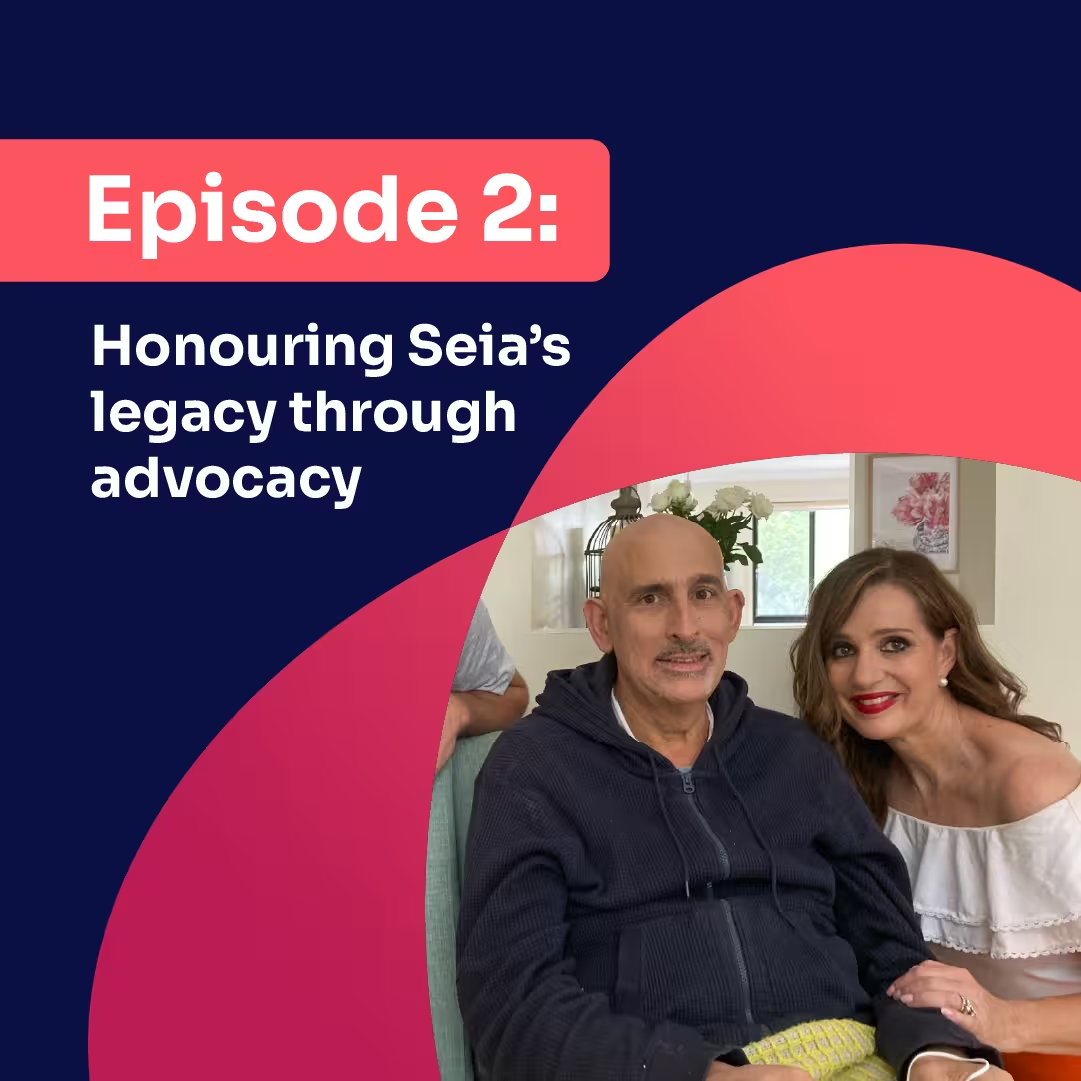
[00:00:02] Kelly: Welcome to the Stem Cell Donors Australia podcast. Today’s episode is a conversation with Rochelle. His husband, Seia, passed away from leukemia in December 2024. Seia was just 53. He needed a stem cell transplant to survive, but finding a match wasn’t easy, especially as someone of mixed Iranian and Australian heritage. Like so many other ethnically diverse patients, Seia faced a brutal reality. There simply weren’t enough people like him on a stem cell donor registry. After losing Seia, Rochelle reached out to Stem Cell Donors Australia with a mission. She’s now one of our most passionate advocates, running in-person donor drives, sharing her story and signing up as many young donors as she can to help save lives. In this episode, you’ll hear about Seia’s diagnosis, the challenges of finding a match in time, and how Rochelle is channeling her grief into action so that no other family has to face what hers did.
[00:01:05] Kelly: Let’s go back a little bit to the beginning of your story as to why we’re here and what brought you to us.
[00:01:12] Rochelle: Well, my husband, Seia, was actually diagnosed with acute myeloid leukaemia back on the 13th of May in 2022. He actually just had a sore throat. And to be honest, he was driving me a bit mad because he was carrying on like classic man flu. And after about a week of that, I said to him, gosh, maybe you’ve got tonsillitis and you might need some antibiotics. You better go to the doctor. And so he did go to the doctor and not even our usual GP who said, yes, I think you’ve got tonsillitis, but how long has it been since you’ve had a blood test? And he said, oh, I can’t remember. And so he had a blood test that afternoon and at 8.30 that night, we had a frantic phone call from one of the pathologists in Brisbane saying, you’re seriously unwell, go straight to hospital. So it was all quite a shock, to be honest, and it all came completely out of the blue.
[00:02:07] Kelly: And so tell us about Seia. What was he like?
[00:02:10] Rochelle: So Seia was a chief inspector at the Queensland Police Service. So he had a love of life. He was notorious for his dad jokes. He was a great prankster. He’d been in the police force for over 34 years. Everybody knew Seia. He was a mountain biker. He had a passion for the water. He used to love sailing and then we got a motorboat. A much loved dad of his two sons, Oscar and Oliver.
[00:02:41] Kelly: He sounds like an incredible husband and friend to all. And it has been quite inspiring to watch you channel your grief into, I guess, this mission. What keeps you going?
[00:02:52] Rochelle: Well, I know that Seia would have, he was always a bit of a jokester, but he was also very resilient and he was very pragmatic. And he always would sit there and he used to call me Chicken Little mainly because I was always the one going, my God, the sky’s caught falling in. And I can hear him in the back of my head saying, good on you, Chicken Little. I just know. And for me, it’s also been there were so many people that wanted to be able to help Seia when he was going through this diagnosis and so many people that wanted to donate stem cells when we were actually looking for one. I guess that’s the thing for me is almost out of respect for all those people that were on the journey with us, I really wanted to be seen to be giving back something to Seia and honoring his legacy. And if we can elicit a change and really get that number of registrations up, you know, it means there was some purpose in what was a really, you know, traumatic period of time for all of us.
[00:03:56] Kelly: Absolutely. And it’s an interesting process being a stem cell donor, it’s so easy to sign up and get on the registry, but a lot of people then think that they will be donating their stem cells straight away, like you would blood donation. But not many people realise you actually just stay on the registry until you are potentially matched with a patient. And so as we’ve discussed, matching is very rare. So stem cell donors can be waiting on the registry for 20 years. And that’s an interesting problem to keep these people interested, engaged, educated, up to date with everything so that, in 20 years down the line, if they get a call, that they still want to say, yes, I will donate to this thing that I signed up for 20 years ago, because it’s still just as important as it was 20 years ago.
[00:04:42] Rochelle: Yes, and really important that when you do register, that you keep in contact and maintain your contact details, because sometimes we get a match, and then things have changed. I think there was somebody who’d registered when he was 18 and he was now, 35 or 38 and he finally was called up to be a match. So, a lot can happen in people’s lives in those 20 years. And that’s why it’s so important, I think, for us to be really, consenting for life. You stay on the donor registry until you’re 60. And it’s really important that people know that when they are called up, that’s often that person’s only chance. So, I think it is really important that everybody goes in there and is really committed to that process as well.
[00:05:31] Kelly: Do you want to talk a little bit about what that actually looks like for the donor?
[00:05:34] Rochelle: Yes, so for the donor, if you are a match, so let’s start back from the very beginning. The very first part of registering is just completing a few medical questions to make sure that you are eligible and then going through and completing a cheek swab. So that’s the very first part, and that’s a very simple process. And that gets mailed off to stem cell donors, and there it sits. If you are called up to be a match, again, there’s a bit of medical screening just to check you’re in good health, et cetera. And then the process begins. And what that looks like is the first thing that we do is we now have an injection, which is not dissimilar to giving yourself an insulin injection, which is a product called GCSF and that stimulates the production of stem cells in your bone marrow. Now sometimes you can feel a little bit achy in the bones because basically your bone marrow is working overdrive, but that’s not dissimilar to, you know, that sort of achy feeling that you might get when you’ve maybe been to the gym or done exercise or, you know, if you’ve got a flu and you start getting a little bit of an ache, but it’s nothing really and some people don’t get that at all. And then you would go into hospital treated like a king or a queen and you’d have two peripheral bloodlines put in. And basically we take the blood out of 1 arm, it goes through the centrifuge and diffuses out the stem cells and then it gets, your blood gets put back in to you through the other arm. So it’s like a long blood transfusion is probably the simple way of saying that. and that lasts for maybe 3 or 4 hours that you’re actually in hospital. If you do have to travel, you are treated like royalty and all your transport costs and accommodation and et cetera are covered in that process because you are giving the greatest gift of life. It really is quite a simple process. Now, I mean, less than 10% of times, do you have to donate via a bone marrow transplant? But that is usually when you’re donating for a very young child. So most people know that if they are called up to do a bone marrow donation, that’s what they’re saving. So it’s not anywhere near as bad as people think.
[00:07:55] Kelly: No, it’s really not anymore. And as you said, 90% of the time you’re in a hospital chair acting like you’re giving a long blood donation or a plasma donation. Completely fine. You get fed, you get to watch Netflix, you get to have a person with you. It’s not a big deal at all. Safe, normal procedure. And then as you mentioned, the other 10%, you’re actually under anaesthetic. You’re not awake with a big needle through your hip, which we’ve seen in lots of dramatic TV shows. You’re completely knocked out, under anaesthetic. You go home that day, you might have a little bruise on your hip that can be managed with Panadol, for example, completely safe, relatively pain-free, and again, you’re saving someone’s life.
[00:08:37] Kelly: Absolutely. We wanted to hone in on that point because, yeah, we’ve seen a lot of clips on TV shows like House, where they’re doing a bone marrow biopsy on a patient and it’s being construed as a stem cell donation, which is not the same thing.
[00:08:51] Rochelle: No, not at all.
[00:08:51] Kelly: Rochelle, I wanted to talk a little bit about how you became an accredited supervisor, so we can kind of educate any listeners who might also be keen to becoming an accredited supervisor with Stem Cell Donors Australia and what that means and how that can help.
[00:09:05] Rochelle: Yes, so basically I reached out to stem cell donors. I think my email was, I want to work for you. So I must admit the team were very prompt and they responded very quickly. I got sent the links to do the online modules. The online modules are very simple. I think they take a couple of hours, but to be honest, if you get in there and give it a red hot crack, I smash mine out in an hour, sent through my certificate to Tina that night and said, I’m done, what’s the next step? Normally we then try to do a one-on-one session and the main purpose for that is really to make sure that our ambassadors are able to answer any of the potential questions that you might be asked by people to ensure that we do get informed consent. And then again going through some of the logistics of completing the cheek swabs and some of the IT issues that can go right and can go wrong, and just really making sure that you really are representing stem cells in an appropriate manner. So that if you went to a group session, it’s probably three or four hours to actually go through that. We are now, I believe, offering some online versions of that. Or, I was very fortunate because Tina was actually on her way to the airport. And I said, great, I’m 8 minutes from the airport, come to my house. And so she did. And we did, a couple of hours and just worked through that together. I think that’s the benefit of really running events. So when I ran the event at the Queensland Police Service, you know, it was so much easier than when we were at West because the police helped me to basically set up half hour sessions and people registered to attend. And I just spent the 1st 15 minutes just telling them a little bit about the story and why it was so important and what was involved, dispelling some myths that it’s a bone marrow biopsy instead of just a long blood transfusion when you’re donating. And then we just walked through the steps together and we got to step three. And I said, right, when you get to step three, stop. And then we did a group swabbing and we all swabbed. It was quite fun. And then we all put them in our envelopes and signed them off. So I feel like that, and that, you know, that way yielded, that yielded over 55 or so, you know, registrations just in half a morning. It was really quite profound. So we’re doing the same thing at Amberley, but I think this is an amazing opportunity I mean, I think we should be calling out to all workplaces to be offering this. One of the greatest ways to keep your employees, and a lot of research shows this, is connected and engaged with your organisation, is to have some cultural purpose and some real focus about giving back. And many companies now have aligned charities and what greater gift than being aligned with stem cells. So I’ve reached out to the mines, I’ve spoken to Glencore and others and they’re all very receptive, will be the logistics of trying to manage that. So I think there’s a huge opportunity to whoever’s listening here. You’ve got a network somewhere, whether it’s sporting, whether it’s at universities, whether it’s in your workplace, that stem cell events could easily be conducted.
[00:12:24] Kelly: Absolutely. And we find in the last couple of years, and we’ve mentioned Tina, I should say, we’ve mentioned Tina a couple of times. For everyone listening, Tina is our partnerships development manager and who runs all the events and trains our accredited supervisors like Rochelle. So she’s on the ground everywhere, all across Australia right now and helping set up these events, which have been milestone for recruitment. So before Tina it started, we were just online, basically. We had people recruit online through cheek swabs, which you can still do, by the way, if you go to our website, you can have a cheek swab sent for free to your own house. You do a quick cheek swab, you send it back and you get on the registry. But we also find that events have been incredibly powerful and touching base with communities, with sporting clubs, we’re looking for 18 to 35 year olds, so workplaces, sporting clubs, anyone who’s got access to those kind of people, that age range, we will leave a form in the show notes to register to how to sign up if you want to get involved and host a cheek swapping event would be amazing.
[00:13:32] Kelly: So is there anything else? Thank you so much for chatting to us today, Rochelle. Is there any other message or anything you’d like to touch on before we head off?
[00:13:41] Rochelle: I think the message that I just want to give is there is a unique opportunity here to really make a difference to an individual, for an organisation to get behind what is a charity that doesn’t want financial gain, just wants to find a match. And to be the perfect match is the greatest gift. So I hope out of this podcast, not only have we increased the number of people that actively reach out to become stem cell donors, whether that is by engaging in a live event or just registering for a home swab kit to be sent and then making sure they send it back, but also for organisations to get behind Stem Cell Donors Australia and actively run some live events in their workplaces to really increase that. And I’d encourage other community groups, because we are looking at that mixed ethnicity. So if you’re a cultural community group, we really need you to help us champion the cause. And I have met some of the most amazing people and heard some of the most amazing stories. Even when we were at West, there was a young girl who lost her father to leukemia. And unfortunately, he passed away post-transplant. But she now runs a fun run every year out of the university to raise awareness and donations for the Leukaemia Foundation. So there’s so many people that have been on this journey that are committed to giving back and I think it is a real opportunity for just anyone to make a difference.
[00:15:17] Kelly: 100% and people really can make a difference. I don’t think they sometimes realise that but even the smallest event, the smallest contact, signing up yourself if you’re 18 to 35, head to our website, the link will be below and sign up as a stem cell donor because you can save a life.
[00:15:32] Rochelle: Absolutely.
[00:15:33] Kelly: Thank you, Rochelle.
[00:15:35] Rochelle: Thanks, Kelly.
Do you have a story to tell?
Every experience with stem cell donation and transplant is unique, and your story could help someone else on their journey.
Whether you’re a donor, a patient, or a family member, sharing your journey can raise awareness, challenge misconceptions, and show others what’s possible.
We’d love to hear from you.
Share Your Story