Episode 3: Stem cell donation through the eyes of a parent
In this episode, Simon shares the deeply personal story of his youngest son, who was diagnosed with acute myeloid leukaemia at just nine months old. What began as a seemingly minor health concern quickly turned into every parent’s worst nightmare, a diagnosis that would change their family’s life overnight.
Simon takes us inside the reality of hospital life, navigating treatment with a baby, and the emotional toll of keeping a family together while living apart.
He also reflects on the moment they learned his older son was a perfect match, and later, the hope that came from a second match found through the donor registry after relapse.
This is a story of resilience, love, unimaginable strength, and a powerful reminder of the life-saving role donors can play.
Listen now to hear how a selfless act gave one little boy a fighting chance.
Listen now:
 Listen on Spotify
 Listen on Apple Podcasts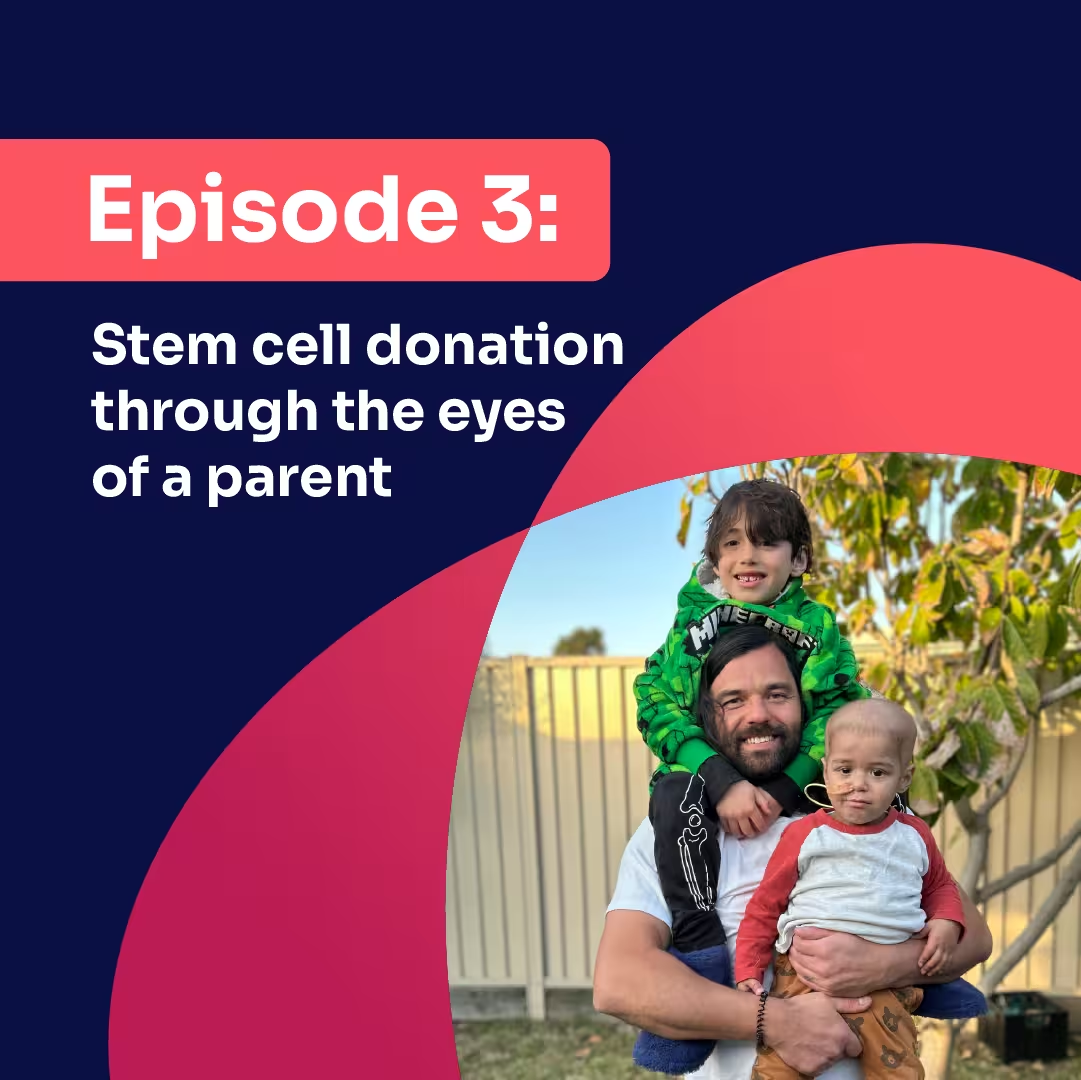
[00:00:02] Kelly: Welcome to the Stem Cell Donors Australia podcast. Today we hear from Simon, who shares his family’s experiences after his youngest son was diagnosed with leukemia as a baby. He shares what hospital life was really like and how it felt to finally find a matching stem cell donor. Welcome Simon to the Stem Cell Donors Australia podcast. Thank you for being here.
[00:00:34] Simon: Thanks for having me.
[00:00:35] Kelly: No worries. So Simon, your son was diagnosed in February 2004, your younger son with acute myeloid leukemia at the age of nine months at the time. So we know he’s had now two stem cell transplants. The second one was just recently completed a few months ago. And the first one was actually the stem cell donor was your oldest son. So, before we get into how that diagnosis came about, can you share a little bit about your family, what your, maybe what your life was like and what your two sons are like prior to the diagnosis?
[00:01:12] Simon: Yeah, I guess there’s, I suppose there’s nothing, there’s certainly nothing special about us. We were just, I suppose, a young family, had a five-year-old son at the time. My oldest son was five. The youngest who was diagnosed was nine months. Prior to that, we were just, yeah, living life normally. My wife was on maternity leave with the youngest. I was still working full-time. I’d recently, in the last few years, started an apprenticeship. So it was starting to get towards the second half of that at the time. And yeah, we were just kind of going about life, just kind of preparing for my wife to head back to work as a high school teacher, sort of in the next few months. But everything was, yeah, just normal, you know, looking after an infant son and trying to chase around a five-year-old just about to start school. So yeah, we’re preparing for that as well. He was, our oldest was due to start school beginning of 2024. So kind of getting ready for that, getting him emotionally ready and to sort of go into a big new world in school, so yeah.
[00:02:14] Kelly: Was he excited for school?
[00:02:17] Simon: He was. I think we were probably more nervous than he was. I think it’s maybe typical of sending your first kid off to school, just wondering about whether they’ll make friends and whether they’ll enjoy themselves and whether there’ll be any difficulties sort of getting to school and that sort of thing. Yeah. Yeah, I certainly was. I can’t maybe speak for my wife in that regard, but I was certainly more nervous than he was, I think.
[00:02:40] Kelly: Yeah, I can imagine. I mean, so you’ve got two young boys, sounds like a handful. Your regular busy life, you guys are based in Victoria. So everything’s smooth. And then tell me about any symptoms. So how did the diagnosis come about?
[00:02:55] Simon: Yeah, so late 2023, so December, I think it was. My wife noticed that our youngest son, when she was changing a nappy, just noticed that one of his testicles looked a little bit bigger, maybe a little bit swollen than usual. And that on occasions when she changed him, it kind of would kind of disappear up into his body. And we’re not doctors. So we thought, well, we don’t know what that is and doesn’t seem normal. So we’ll get that checked out. So my wife took him to the GP and they sort of sent him off for scans and just to sort of check in with that symptom, I suppose, just to see what that was. Initially, it was diagnosed as something just completely unrelated to leukemia. And, basically we were told that it wasn’t anything particularly urgent, that what they thought it was, could wait to go see a specialist in February 2024. So we sort of booked in to see that specialist and didn’t really worry us. To be honest, it was, you hear about kids becoming really unwell and that didn’t really enter our mind. We just thought, well, this is just something we’ve just got to get through. And it really was not forefront of our minds, given that they’d said, you know, can wait, we’ll go and see a specialist in a month or two. Then, yeah, everything was relatively normal in January. But towards the end of January, he started to get sort of gastro-like symptoms sort of came on very suddenly around the end of January. And I remember getting a phone call from my wife. I was at my parents’ place at the time. She’s like, oh, you got to come home. He’s starting to vomit. I’m a bit worried about him sort of thing. So yeah, I think it was that night we made a phone call to emergency, like this online thing that they’ve got, just sort of had him sort of went through the symptoms and had him checked out. And at the same time, he had kind of a bit of a red looking eye, like his eyelid was sort of getting a bit puffy. and they’re like, the way they’re talking about it was that’s possibly unrelated, maybe an infection in his eye and yeah, probably gastro.
So the next day we took him to a GP, basically confirmed, yeah, infection in the eye, gastro, his sort of two different treatments, I suppose, you know, we’ll treat the eye as an infection, we’ll treat the gastro, you know, just give him some fluids, you know, the normal sort of scenario that you get from a GP, I suppose, in that situation. I suppose the next couple of days after that, kind of went between getting better and then going downhill again. And his eye was getting more swollen. And we’re like, well, this isn’t helping. Like, there’s obviously something else going on here. Took him back to, took him to another GP and they basically said, yeah, straight to emergency. Like, okay, well, obviously the eye’s, you know, pretty significant. We didn’t, we still thought, you know, gastro at that stage. I think they were more worried about the eye. So yeah, went to emergency at the Northern Hospital. They did some tests and stuff like that. By this stage, I got to the hospital, so my wife had been there with our son. I got to the hospital and they sort of said, Okay, well, we’re going to transfer you over to the Royal Children’s. We’ve got brain specialists, blood specialists, all those specialists waiting for you at the Royal Children’s. And I’m like, Well, that’s weird. What’s going on here? This is a, you know. They talked about sort of, they’d given him a scan as well of his brain and they sort of talked about having these not masses, but just things that were kind of, didn’t look particularly good behind his eye. And so, we, even at that stage, we were kind of thinking, oh, this sort of stuff doesn’t happen to us. this happens on TV, this happens in the movies. Like, you know, he’s going to be fine. We’ll go to the Royal Children’s. They’ll sort him out. Might spend a couple of days in hospital. So, yeah, we got, well, my wife and him got transferred over to the Royal Children’s. I came later in a car, did some more. This was late at night by this stage. that we were getting, or that he was getting more blood tests in emergency. They basically took him straight through to a room and we’re keeping an eye on him, taking blood tests, all that sort of thing. And I think at that stage there was mention of cancer, but again, we were so naive. Like we just thought this doesn’t happen to us. Like there’s no way it’s cancer. Like, or maybe we’re just, maybe our brains are just telling us that, I don’t know, just trying to protect us, I suppose. But by this stage, we’d look into kind of the different wards and what they did. And we knew that Kookaburra ward dealt with cancer and we got told we were heading up to another ward. So then like me and my wife were messaging each other, we still got the message to this day just to say, oh, we’re going to this other ward. That’s a good sign. It’s not the cancer ward. And yeah, we sort of spent the night in that ward. And then I can remember it very clearly. I went down and got breakfast. They got Maccas there, so I stocked up. I was starving. I hadn’t eaten all night, neither of my wife. Stocked up on Maccas and came back to the room and just a stack of doctors came in at that point in time and they were like, you know, set us down and went through the symptoms again, like what had sort of led to us getting to emergency and then to the children’s hospital. And at that stage, like, I know I was thinking like, oh, they’re still kind of investigating what it is because they’re still asking questions about the symptoms and all that sort of thing. And then they basically just, Austin’s oncologist said at that point, look, your son has leukemia. And like that just, like it was just, it didn’t feel real. It didn’t, it just felt like, you know, just a nightmare, like a bad dream. Because we’re so, again, I’ll speak for myself, like I was so unprepared for that, despite him being so sick and, being in hospital and everything like that, like just wasn’t, I wasn’t prepared at all for that. And then that’s basically when our whole kind of world got turned upside down. And, you know, I’m sure there was a lot said in that meeting, but I can’t really remember much of it beyond that.
[00:08:53] Kelly: No, I don’t think any mother or father can ever prepare to be told something like that. It’s not, it’s almost inconceivable at the time. Yeah. Wow, so he was only nine months at the time, so. So from there, I would imagine he probably didn’t go home.
[00:09:33] Simon: No. So again, that wasn’t really wasn’t really something I thought about at that initial time, like, yeah, we got told that he’d be going through chemo pretty much immediately. So there was nothing about transplant at that point in time, because I didn’t really know what type of leukemia. So yeah, started chemo straight away and probably wasn’t until maybe a week or a few days later, his oncologist came and spoke to me and I think I was might have been by myself at the time, my wife might have been at home. And he sort of said, this is what your year is going to look like. And I was like, year? So What are you talking about? And it was essentially that, this is the type of cancer that, or type of leukemia that he’ll be mostly in hospital for much of his treatment. There are obviously, you know, other types that, you know, you spend periods in hospital here and there, or if you get unwell, obviously you go back into hospital. But yeah, we spent probably a good couple of months initially in hospital, sort of, they didn’t really, I think they don’t really give you too much indication of how long, but they basically said he wouldn’t be going home within the first two rounds of chemo, so possibly a break after the second round between 2 and 3. So that was pretty brutal and it was interesting. Like you see other families come in and get the diagnosis and it’s horrible seeing that other families having to go through the same thing that you went through sort of a couple of weeks before or a week before or whatever. And then, they get to go home for a period of time like we did in that first, and you’re like, God, we’re all unlucky to be in that situation. But having to spend a couple of months in hospital first up, that was pretty hard.
[00:11:16] Kelly: Yeah, 100% that you go to a doctor thinking that your son has gastro and then you’re not home for two months. That’s not ideal.
[00:11:24] Simon: Yeah. I mean, and I’ve said all throughout this that as unlucky as we are, we’re so lucky that we’re only a short distance from the hospital. There’s other families that have to travel, either they’re from interstate or from, regional areas of Victoria. Like, you know, we’re unlucky to be in this situation. We’re also so lucky that the circumstances, our own personal circumstances.
[00:11:46] Kelly: So how did logistics work between you and your wife staying at the hospital and managing the other son at home? Did he end up going to school?
[00:11:55] Simon: Yeah, so as it turned out, so the diagnosis, we got the diagnosis the day before he started school. So it was kind of, you know, we didn’t really, we didn’t really know much about taking a kid to school or anything like that. It was our first experience of it. So quickly managing, managing him and keeping things as normal as possible for him right from the get-go was kind of one of the most important things for us. So it wasn’t a case of, you know, we want to not let him start school or anything like that. It was kind of a focus on how can we make this work? And so obviously contacted the school, spoke to his teacher. She would have hardly known us by that stage. So just calling up and saying, oh, by the way, his little brother has cancer. We’ve kind of got to change our plan for the year. Especially when you’re still trying to process it yourself. Like I still haven’t really processed, obviously, the diagnosis, but then still having to talk to other people about it. Yeah, it was hard. But yeah, we sort of had a plan to kind of make sure that we kept things normal as possible for him. And so that meant, so my wife was breastfeeding at the time, so it wasn’t really an option for me to sort of stay at the hospital overnight initially. But yeah, my wife did sort of… four nights, I think it was initially, and after the fourth night, and I could completely understand it having done it now, she was just like, I can’t do this every night. It’s really hard to do one or two nights, let alone multiple nights in a row. So kind of made the plan that as hard as it might be because she was breastfeeding, we just do it. We do do one night each at a time. And since then, it’s pretty much been that, just taking it in turns. And I suppose the plans work because as much as because we might have a bad night at hospital, at least we’ve got the next night to recover. And it’s obviously an abnormal situation for our oldest son, but he gets to see us regularly, each of us regularly. And while we don’t spend a heap of time together as a family, or haven’t spent a heap of time together as a family last year, at least he gets to see me every second night and see my wife every other night. We still drop him off at school, we still pick him up from school. Like there is that kind of, that was important to us to keep that normal for him.
[00:14:04] Kelly: Yeah, completely. So tell me about when you first heard of a stem cell transplant.
[00:14:12] Simon: So it was kind of, it was said to us in the initial week or two that we were there that, some, probably the first couple of days really, some types of AML require a transplant. And remember, our oldest son was visiting the hospital in the first couple of days and the doctor just looked at him and said, we’ve got to get him tested to see if he’s a match for his little brother. And So we got him tested. We didn’t really know anything, like even though they talked about a transplant, we like, in my mind, you’ve got this, I think I had this like kind of picture in my head about this really painful procedure that they put a needle in your back and, you know, take fluid out and yeah, and didn’t really know much else after that. I was kind of my current concern at that stage was probably for my older son. And he was, yeah, he was tested. And then they sort of said it would take a few weeks to get back the results about where there was a match or not. We kind of, we’re in the thick of that first round of chemo and obviously our youngest son went in there being very unwell to start with. So it was kind of just managing his illness and kind of not really focusing too much on that test, whether our oldest son was a match or not. We got told that, and I don’t know how true this is, I actually never looked into it, but that he’d be a 25% chance of being a perfect match. I remember oncologist and the nurse coming in one day. I was at the hospital and said, you know, we’ve got great news, he’s 100% match. And yeah, now that was, we’d obviously been focusing on other things, but that was such a, like, probably the best day out of that, that period.
[00:16:00] Kelly: Yeah, absolutely. Because finding a match is quite hard for anyone. There’s over 36 million donors on the global registry. And often people who are searching for a match might only have one match if they’re lucky. So it’s always awesome when we hear that a sibling or a family member is 100% match and they don’t actually need to go and search the donor registry.
[00:16:09] Simon: Yeah, look, it didn’t, it didn’t even occur to us until sort of later on how hard it is to get a match. Like, we’re again, like, you know, as unlucky as we are to be in this situation, we’ve been so lucky that our oldest was a perfect match and that, you know, that process was fairly straightforward. You know, apart from, I suppose, our oldest son’s sort of feelings about that, wasn’t, wasn’t super keen on, on doing it. Maybe we were a little bit too honest with him about what it involved. Yeah, if I had my time again, I probably wouldn’t do it that way.
[00:16:39] Kelly: For those who don’t know what a stem cell transplant is, are you able to explain that?
[00:16:44] Simon: Oh, look, I don’t really completely understand the science behind it, but essentially it’s taking the stem cells out of a donor. And another thing that baffled me completely, that it was just a simple blood transfusion, essentially, that went into our youngest son. And so he’s had loads of different blood transfusions and platelet transfusions. And essentially it was the same thing. It was like getting a, receiving a blood donation basically.
[00:17:09] Kelly: Yeah, that’s right. And a lot of people think, as you mentioned, like it’s initially everyone thinks it’s quite painful, you know, being a stem cell donor, that you have a big needle in your hip or your back and you’re awake and it’s excruciating, but it’s actually not. It’s to be a stem cell donor is very much like a plasma donation and you’re sitting there in a chair in a hospital, comfy chair with two needles in your arms. One draws out the blood, takes the stem cells and gives your blood back in the other arm.
[00:17:37] Simon: Yeah, so yeah, leading up, like once our oldest son knew that he was a match and was going to be a donor initially, it was excitement, but then very quickly it became concern about, you know, because of his age and how they were going to take the stem cells. He got put under and he had a procedure not that long before. And he’d been put under before and he hated it. was like, it wasn’t done at the children’s hospital. They’re amazing at making kids comfortable and all that sort of thing. But it was done elsewhere and he had a real fear of getting put to sleep and what was going to happen and really took a lot of work by us and the hospital around making sure that he was prepared for it and understood what he was doing. Like we, myself and my wife, really, we wanted him to have a choice, but we also knew that there was no choice. So it was kind of gently saying to him, well, we kind of have to do this. And, you’re super brave and you’re a hero. And, unfortunately, this is something we need to do. And by the time it came to actually the day where he had to go under and donate and stuff like that, he was so excited. Oh, good. He did a good job. Yeah, he, you know, couldn’t while the smile off his face. He was very well prepared. the hospital were fantastic about, preparing him and making him comfortable. And, he was excited about having to spend or wanting, being able to spend a night in hospital after the procedure, which, that’s because of his age and the procedure, that’s why. But otherwise, obviously, adult donors don’t have to do that.
[00:19:10] Kelly: Yeah, that’s actually a good point. So, the blood draws that I just described, that’s 90% of the time, it’s PBSC, what they call it. But often, when you’re donating to a young child, they’ll do it via the bone marrow, which is, as you just said, under anesthetic. And so, yeah, you’re often, even with adults, if there’s a matching stem cell donor and that the donor is donating to a child, they’ll go under. And again, not painful, you’re under anesthetic. The stem cells get drawn from your bone marrow and it’s usually about an hour procedure, I think.
[00:19:40] Simon: Yeah, it wasn’t very long at all. Yeah.
[00:19:42] Kelly: Pretty, pretty cruisy.
[00:19:44] Simon: Yeah.
[00:19:45] Kelly: How was he when he woke up?
[00:19:46] Simon: I think he was in a little bit of pain, but he sort of, we’d sort of planned it so that… but he’s got a very close relationship with his uncle, with my brother-in-law. So we planned it so that he would be there when he woke up and had a present for him and stuff like that. So I think he was really happy with that. Like I said, a bit of pain, but that was managed pretty well. By the time he got up to the ward, he was laughing and smiling and having a great time. I think he loved the attention.
[00:20:14] Kelly: Yeah, that’s awesome. It’s awesome that you were able to get into that state of mind.
[00:20:16] Simon: Yeah.
[00:20:17] Kelly: So that’s the first transplant. And it took, it went, he went really well for a little bit.
[00:20:22] Simon: Yeah, it went great.
[00:20:24] Kelly: And then tell me what happened.
[00:20:26] Simon: So yeah, we, so the transplant was in June 24 and by sort of early August we were out of the ward. My son was ringing the bell, celebration bell. And yeah, like things looked like they were gonna go back to normal. Like it was, I suppose it, relatively difficult few weeks sort of moving home, having us all in back in the house permanently. Like we’ve had, we’d had periods at home together, but I suppose it was, getting used to giving medication and all that sort of stuff, via his NG tube and I don’t know, kind of trying to get back to normal as well. And, you know, it didn’t take long where things started to feel like we were really, you know, travelling really well. Both of our kids were really happy to be together and spending time with each other finally after such a long time. And he was, some was happy and healthy and doing really well. Obviously going back to hospital for routine tests and checkups and that sort of thing, but everything was coming back really well. Yeah, and then it wasn’t. He had a routine test in November and that came back with some leukemia cells were in his bone marrow. And like that, like it was, it’s weird because I had that day, I had a really bad feeling. And I know like maybe it’s parents’ intuition on something, I don’t know, but I just had a really bad feeling and pulled into the driveway and my wife came out to the car, which she never does. I came out of the car and said, oh, doctor wants to speak to both of us on the phone in 15 minutes. I’m like, well, that can’t be good. And yeah, I said on my couch, waited about half an hour for the phone call, which was even worse. And yeah, he said to us that, yeah, leukemia cells have been found again. And whilst it wasn’t classified at that stage as a full relapse, sort of, kind of it was really gutting at that point because he’d been through so much and we were so kind of, all the tests had been fine up until that point. And yeah, it just kind of flawed us really, like in some ways it was worse than the initial diagnosis because, you know, we obviously had been through it all before and having seen what he went through and then it still came back, it was kind of in floored us. So we’re walking around like zombies for a week or so, I think after that phone call, just kind of not really knowing what to say, not really knowing what to do. Yeah, it was rough. But they kind of put in a treatment plan for that month or throughout December or end of November, December to try and get rid of those cells. He had another test day before Christmas, 24, and doctors asked us, do you want the results when we get them or do you want to wait until, enjoy Christmas, that sort of thing. And we’re like, honestly, we just want to enjoy Christmas. We don’t want to think about it. So yeah, let us just enjoy that. And then when you need to, let us know. So as it turns out, our appointment was on New Year’s Eve. So we went into the hospital on New Year’s Eve during the day and yeah, got told that unfortunately he’d relapsed and yeah, that he’d require more chemo and another transplant.
[00:23:31] Kelly: So they told you straight away would need another transplant.
[00:23:35] Simon: Yeah, so on that, when we were told that officially because the cells had been found elsewhere. that he’d officially relapsed and that he would require another transplant. I don’t think I’d even thought about that possibility before that was said to us, to be honest. Yeah, I don’t think that there was any reason for us to look up whether you needed a second transplant.
[00:23:55] Kelly: And so did they explain to you now this time they needed to go on to the global database for research.
[00:24:00] Simon: Yeah, so. I think it probably comes with the territory of, there not always being a match on the registry. So, I think it was said, we’d go to the registry, but also we’re going to get both of myself and my wife tested. We’re obviously never going to be a 100% match for him, like probably closer to 50% because he takes it sort of half from me, half from my wife. So, yeah, they sort of said that, you know, we’d both get tested and then we’d, I suppose, the better match out of the two of us, the healthiest out of the two of us would probably be used and that’s what we had in our mind but that’s what it was going to be and yeah it actually wasn’t that long later that we found out that there was a potential match and on the register and we potentially wouldn’t really have to worry about us not being a full match.
[00:24:48] Kelly: So they must have found a pretty good match so they usually rank it out of 10 like an 8 and 9 or 10 out of 10. Do you know what the match was?
[00:24:56] Simon: I think there was it might have been a 9 out of 10 or something like that. which, how was it explained to us was that the one that it’s sort of missing didn’t matter too much. And that, it was essentially 100% match.
[00:25:09] Kelly: Oh, that’s so lucky.
[00:25:11] Simon: Yeah, so like again, like we haven’t had this experience of like waiting around for a match or anything like that. So we’ve been so lucky to have found two matches within the space of sort of 18 months.
[00:25:26] Kelly: And had you spoken to other families on the ward who were waiting for matches?
[00:25:32] Simon: We’d spoken to not necessarily waiting for a match or I personally hadn’t spoken to anyone about waiting for a match. I don’t think my wife had those conversations, but certainly I’ve spoken to families that the parents were the donors. So again, not a perfect match. And so yeah, obviously clearly they hadn’t found a match on the registry because they’d gone down that route. So yeah, it wasn’t, it’s funny you kind of, you’re living day to day in this space and you’re probably not, or certainly I wasn’t, thinking too far ahead, you know, kind of just dealing with things as they happened. So it wasn’t, yeah, I suppose it wasn’t really thinking about necessarily whether there wouldn’t be a match on the registry.
[00:26:12] Kelly: Yeah, well, that’s good. Because, yeah, unfortunately, we do know, we do know patients who have been searching for months and months and still can’t find a match. Did the doctors kind of mention how the heritage and ethnicity of the donor and the patient plays into how well that match is?
[00:26:27] Simon: Yeah, well, they, I remember just looking into it a bit more around how hard it is to find a match and obviously hearing about kids that had their parents as donors and had a conversation with the doctor about, one of the doctors about, you know, how easily our son happened to find one, then like, yeah, well, you know, generally speaking, when you’re, I suppose, white Australian, for lack of a better explanation, like, you know, you’ve got a much better chance, there’s much, much more, I suppose, availability of matches on the register. And the more I think about it now, the more I think that that’s even bizarre because like, you know, my wife’s Italian background. I’ve got, my grandfather was Indian, like where our son’s, you know, a mix, and yet somehow, yeah, managed to get a pretty good match.
[00:27:12] Kelly: Yeah, that’s incredible. Do you know anything about the donor? Just, it was an Australian donor or overseas donor.
[00:27:18] Simon: As far as I know, they were Australian. You know, you don’t really get much detail, which is fair enough. Like, I think it’s, yeah. That’s another thing. I suppose if you are going to donate, your details are sort of kept pretty safe.
[00:27:34] Kelly: There’s definitely an anonymity about it. They don’t share the details.
[00:27:38] Simon: Yeah.
[00:27:38] Kelly: But I’m not sure if you guys know, you might, that after two years of the anonymity… the donor and the patient get an opportunity to share details.
[00:27:48] Simon: I didn’t know that.
[00:27:49] Kelly: Yeah, so we do love donors and patients who have eventually years later met up and contacted each other, which is kind of cool. It’s nice that you have that option, but yeah, the first two years while everything’s settling and the transplants taking place, definitely no contact.
[00:28:03] Simon: Yeah.
[00:28:04] Simon: Well, that’s awesome to hear. I mean, yeah, it would be nice to get that opportunity to thank that person if they were open to it.
[00:28:14] Kelly: Keep that one up your sleeve.
[00:28:15] Simon: Yeah, definitely. Yeah. Well, I mean, that’s up to them really. At the end of the day, I’m sure we would jump at the chance, but yeah.
[00:28:24] Kelly: It’s nice. We’ve read some letters that have been exchanged. It’s pretty cool.
[00:28:28] Simon: Yeah.
[00:28:28] Kelly: So he’s had his second transplant. How long ago now and how’s he traveling?
[00:28:35] Simon: He had it about a month ago. I think with any kind of, when you’re having chemo and transplant and that sort of thing, there’s always going to be ups and downs. And there’s certainly been nights that we don’t get any sleep, and then he doesn’t get any sleep. And yeah, there’s certainly been days where he’s been very unwell, and nights that he’s been very unwell, but he’s an extremely strong kid. They all are, all those kids that are battling through transplants and cancer and all the ones that we’ve met are just so resilient and so strong. And he’s just one of many. Unfortunately, there’s a lot of them. Yeah, he’s really strong and he, unfortunately, he doesn’t really know any different. So this has been his life for a long time now, but he just, like we do, he just kind of gets on with it. And, he’s one of those kids that can have procedures done and can feel unwell, but as long as he gets a cuddle then he’s fine.
[00:29:33] Kelly: He wouldn’t even be 18 months yet, is that right?
[00:29:36] Simon: He’s two years old now, so he’s nine months at the beginning of last year when he got diagnosed. Yeah, we got to have his second birthday at home this year, which was good. Got a bit of time at home in between the first round of chemo and his transplant, so that was nice.
[00:29:50] Kelly: It’s about it would be after all that time apart. It’s very difficult being in a hospital and the family split up and parents are split up, brothers are split up, like it takes a toll.
[00:30:00] Simon: Yeah, I think that’s the hardest part. Personally speaking, for me, that has been the hardest part, not all being together as a family. You know, you see both of our sons, they’re the happiest when they’re together and when they see each other. So having them apart is really hard. Yeah, there’s a lot of hard things about it, but I think that’s probably the hardest for me.
[00:30:22] Kelly: And so recently we came across your story at Stem Cell Donors Australia, because I imagine now after being through all of this and having your son have two stem cell transplants, and as you’ve mentioned, being so lucky enough to have these transplants as options, you’re wanting to share your story in the hope to get more donors on the registry so that patients don’t have to wait as long to get their donor, to get their matching donor.
[00:30:49] Simon: Yeah, that’s right. Now we have conversations all the time with other families that are going through this and like it always at some point leads to, you know, how we can make life on the ward easier for other parents that, you know, get that diagnosis or, you know, how we can make it a bit more fun for kids on the ward, you know, donating toys or, you know, donating food. to put in the cupboard for parents when they’re first coming into hospital and haven’t really organised all that sort of stuff. Like, we’re always talking about ways that we can make it easier for future families. And I thought, well, looking into it, I thought of doing something like this a while ago, but I didn’t really know how to go about it. try and get people to sign up on the registry. And it’s only through like looking into it that I’ve really seen just how hard it is to get people to sign up and how hard it is to find matches and that sort of thing, like looking into it. So I thought, well, when I stumbled across the Stem Cell Donors Australia website and that they run appeals, if you’re happy to share a story, and I thought, well, this is exactly what I want to do. this is exactly what I thought of doing. So yeah, might as well give it a crack and yeah, hopefully get some people signed up.
[00:31:59] Kelly: Absolutely. Because we are critically low on donors in Australia. We’re actually one of the lowest registries in the world that have donors. Some other registries, for example, Germany, they used to have them kind of into their culture. But In Australia, it’s very different. Not many people know about us. Not many people know about stem cell transplants, how they can save the lives of patients living with blood cancers or disorders. There’s a lot of misconceptions that we battle about how painful it is, the process, the procedures. So when we meet people like you and families like yours who are willing to share their story and their journey It makes a huge impact to help others understand the process and to want to join to become a stem cell donor.
[00:32:53] Simon: Yeah, yeah, it’s interesting. I’ve spoken to a lot of people that are kind of over the age. The 35 year old, like a lot of 40 year olds I’ve spoken to, you know, they can remember signing up to be an organ donor when they got their license at 18. And I did the same thing when I was 18. You know, it’s like, well, I’m not gonna need them at that point, so I’ll happy to donate my organs and Just like the fact that I’m 40 years old and had never really heard of the registry, I thought, well, that’s got to change. Even if it’s just a small step towards getting people made aware of it, start the conversation around how easy it is for a start and how easy it is and how much it makes a difference to families and particularly kids. I know obviously it’s adults are going through Similar things as well. But yeah, it’s obviously got a long way to go to potentially get an opt out system. But even if there was more information around that period that people are getting their license and turning 18 and yeah, I mean, that would be the ultimate goal. But yeah, absolutely. Start small.
[00:33:57] Kelly: Yeah, get them in there when we’re 18 or they’re signing up to the police or the cadets or even at school. We’re not able to go into schools at the moment. But we, because we’ve got an aging registry as well, because again, not many people, the young guys don’t know that we exist. So, people often 35, 40 have got some lived experience. I’m more than happy to join, but we do have an age limit. So if you’re listening, it’s 18 to 35 to join the Stem Cell Donors Australia registry. You can do that via our website. A simple cheek swab is all it takes. It gets sent free to your home. You swab your cheek, send it back, and you’re on the registry. And the reason for the age limit is younger donors have better patient outcomes. So as we get older, our stem cells are not as many in the body. Males are often preferred, mainly because they have more stem cells. So from a recruitment perspective, we need to target younger generations so that our registry doesn’t get too old.
[00:35:03] Simon: Yeah, and I suppose that’s another point as well, that sort of in my reading a bit up, reading a bit about it recently and talking to people that are sort of 33, 34 years old, and they’re like, oh, well, I’m only going to be on for a couple of years, so what’s the point? And it’s like, well, actually, no, you register up until you’re 35, but you stay on the register until you’re 60, I believe.
[00:35:21] Kelly: That’s correct.
[00:35:22] Simon: So it’s certainly not a waste of time, even if you’re 34 or 35 years old now.
[00:35:27] Kelly: Yep.
[00:35:28] Simon: Yeah, it can still help.
[00:35:29] Kelly: Absolutely, yeah. And people get selected at all different ages. If some people, the only match they can find is a 45 year old, then they’re going to do that, right? Because often, as we know, it becomes the last option of treatment. So you don’t often get offered a stem cell transplant unless your chemo and your other treatments have failed, they’re not working. It’s a last resort. So when you’re searching for a donor, it’s pretty much life or death at that point.
[00:35:57] Simon: Absolutely. Like we’re under no illusions that our son is still fighting for his life at this point. You know, we know it’s a long road. And yeah, so, you know, we’ve at least been given a chance. And that’s, we’ve been given two chances. And that’s an amazing feeling, that someone has kind of given the ultimate gift of giving us a chance, giving our son a chance.
[00:36:21] Kelly: Yeah, it’s pretty cool that like a kind of stranger has said yes to this, you know?
[00:36:26] Simon: Yeah, I can’t even imagine what that’s like, you know, obviously not being able to register myself because I’m too old. Just getting that phone call to say, we’ve got someone for you. We’ve got someone for you to donate to. You can save their life. I think that would just be the most incredible feeling.
[00:36:42] Kelly: Yeah, I agree. I’m on the registry. I’ve not donated, but I often talk to people who have donated and that’s what they say. They said it’s the best feeling in the world and they would absolutely do it in my heartbeat. So it’s pretty incredible.
[00:36:54] Simon: Yeah.
[00:36:56] Kelly: So people listening can’t see Simon, obviously, but I can. And he has a pretty lush head of hair that I’m looking at. And so Simon, tell me your goal and what might happen to this lush hair of yours if you reach this goal.
[00:37:13] Simon: Well, it’s the beard and the hair. So once, yeah, I’ve got, I suppose, shoulder length here, I suppose you call it. Yeah, the goal is once to get to 100 people that have registered. So sent in their swab and gone on the registry. I’ll shave my head and shave my beard. And yeah, the plan is to donate my hair. So hopefully, the plan is hopefully, you know, another patient can get some use out of this hair, maybe, if it’s any good. Hopefully it is.
[00:37:43] Kelly: Yeah, that’s a beautiful mission, Simon. And if those of you who want to support and go between 18 to 35 and want to become a stem cell donor, you can head to our website. There’s an appeal section that you will see Simon’s appeal. You could also head to our social media where you’ve got the link in bio. And so, if we get 100 donors, Simon is going to shave his head and beard. Have you ever done that before? Have you ever been short hair?
[00:38:09] Simon: So for much of the last 20 years, I’ve had long hair. I did have a haircut when I had to get a job. So I had a haircut then and probably had short hair for two or three years. But yeah, pretty much been growing my hair for the last two years. It was getting pretty long at the beginning of last year when our son was diagnosed. And I thought, you know what, there’s no point getting a haircut, I might as well just keep growing it. And then turns out there’s a pretty good reason for it now.
[00:38:34] Kelly: Yeah, that’s awesome. And why not donate your hair? People need it, right?
[00:38:37] Simon: Yeah, exactly. Yeah. I mean, if they’ll take it, then I’m happy to give it. That’s fine. And I suppose for, I was just gonna say for other, for people that are over the age limit to register. I’d just say encourage you to speak to your kids you know speak to the young people in your lives, you know get them to listen to these podcasts get them to read up a bit about it because although you know you might not be able to register yourself like I think you can make a difference anyway by talking to other people about it.
[00:39:05] Kelly: Absolutely and you can host donor drive events in your community if you’re part of a sporting community that’s always a good place to recruit donors workplaces lunch and learns we’ll leave some links in the show note for you to reach out, but there’s always something you can do if you’re interested. So, thank you, Simon. Is there anything else that you’d like to say before we jump off?
[00:39:28] Simon: No, thank you for having me. And so that’s been good. Thank you.
[00:39:31] Kelly: Wish your little one the best.
[00:39:33] Simon: Thank you very much.
Do you have a story to tell?
Every experience with stem cell donation and transplant is unique, and your story could help someone else on their journey.
Whether you’re a donor, a patient, or a family member, sharing your journey can raise awareness, challenge misconceptions, and show others what’s possible.
We’d love to hear from you.
Share Your Story