Episode 6: What it’s like to donate bone marrow
When Sam received a phone call telling him he was a perfect match for a patient in need of a stem cell transplant, he was completely caught off guard. In fact, he didn’t even remember joining the registry.
In this episode, Sam shares how a community swab drive he attended years earlier led to the opportunity to save a life. He takes us through the entire donation journey, from learning he was a 100% match to undergoing a bone marrow donation procedure — a donation method used in only a small percentage of cases.
Sam speaks candidly about the testing process, donation day, recovery, and the questions he had along the way. His story is a powerful reminder that signing up to the registry only takes a few minutes, but could one day give someone a second chance at life.
Listen now:
 Listen on Spotify
 Listen on Apple Podcasts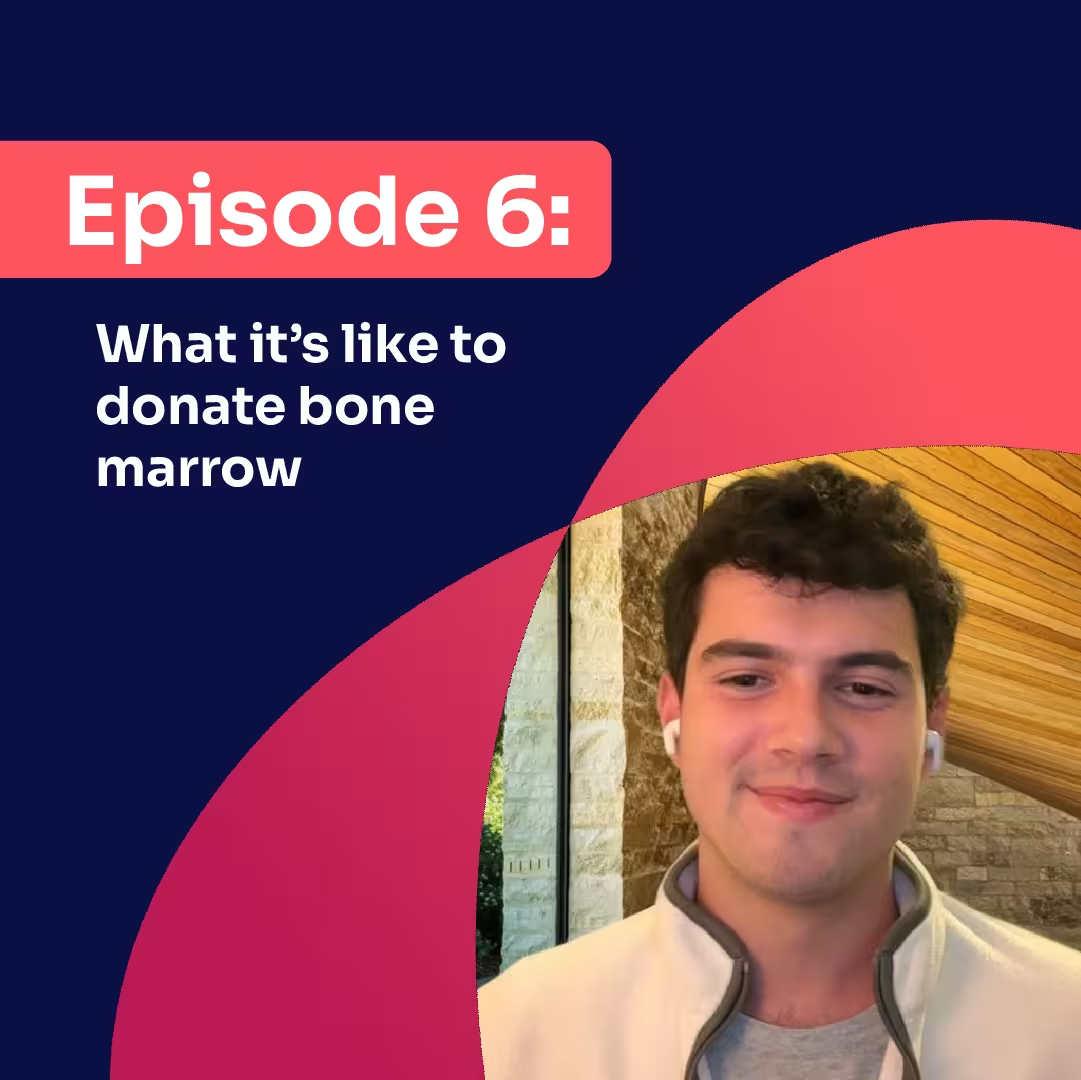
[00:00:02] Welcome to the Stem Cell Donors Australia podcast.
[00:00:12] Dan: Sam didn’t expect to get a call saying he was a perfect match for a patient, mainly because he didn’t remember joining the registry in the 1st place. In this episode, he talks about how a community swab drive a few years ago led to that moment. Sam is one of the few donors who donated via bone marrow. So we unpacked what that actually involved, how it felt on the day, and what recovery looked like in the weeks after.
[00:00:36] Dan: Sam, welcome to the podcast. Thank you for joining us.
[00:00:38] Sam: Thank you for having me.
[00:00:39] Dan: No worries. Did you want to start off by telling us a bit about yourself?
[00:00:43] Sam: Yeah, sure. So, my name is Sam. I’m 23 years old. I currently work full-time in tech as a business development rep, fancy term for sales, and have a side hustle called Billy, essentially just creating an app for Aussies to manage and pay their bills in one app.
[00:00:59] Dan: I love it. So Sam, thank you again for joining us on the podcast today. You’re one of the unique few who actually donated by a bone marrow biopsy. As we tell people, nine times out of 10, it’s usually via apheresis. So it’s great to actually be able to talk to somebody who went the other direction.
[00:01:15] Sam: Yeah, definitely. Grill me as much as you want. I’ll be as truthful and as honest as I can be.
[00:01:21] Dan: That’s what we want to hear. All right, so let’s start from the beginning. Tell me how you joined the registry because I hear there’s a bit of a story behind that.
[00:01:29] Sam: Yeah, a bit of a wild one. It’s a really interesting case here. So I’m not going to start in chronological order because it adds to the story if I don’t. But after the Bondi event happened back in December last year, I was on holidays. It was around Christmas time. And I walked into Lifeblood, local Lifeblood, around the corner from me wanting to just donate blood because there was a lot of blood in need. I walked in, I filled out the paperwork and I went to the desk. I was like, all right, ready to donate blood. And they turned me away and they said to me, we’re booked out for three weeks. And I said, okay, I’ll book when I get home. I’ll do it online. So I went home. Obviously the day got better of me. I didn’t end up booking in.
But a week later, I got a call from a lovely lady, Michelle, from Stem Cell Donors. And she said to me, I’ve been identified as a match. And that raised alarm bells in my mind because I was thinking that I never donated blood the week prior when I walked into Lifeblood. So I didn’t bring that up. I mentioned to her, what does this mean? What’s this organization? What do I need to do? And she basically explained to me that there is a person in need of stem cells as they have some sort of blood cancer, and I’ve been identified as a match on the register that my stem cells could potentially be helpful for this patient. So at the end of the call, I said, Michelle, if you don’t mind me asking, how did I come up on this register? I’ve never donated blood. I’ve never done a swab. I’ve never done anything anywhere. And she said to me, really good question. I don’t actually know. I’ll need to find out. So she put me on hold, and I was on the line for about two minutes. And she came back to me and she said, about two, three years ago, you attended some event where you did a swab and that’s how you’re on the register. I had no idea what she was talking about. Honestly, I was very skeptical. I didn’t recall going to any such event where I had given a swab and electively went on the register. So that was that. Later in the day, I was with my dad and I explained to him this whole story and he said, yes, there was a really sick boy in our community that the community had a drive, a donor drive at the synagogue and that was where I had the swab. And after he explained and jogged my memory on that one, I actually recall going and doing it with my siblings and a whole bunch of friends. There were hundreds of people there, which was quite amazing. And that was how I was found.
[00:03:54] Dan: You know what’s funny? I was actually the one who gave you the swab at that event. I remember it well.
[00:04:00] Sam: Really.
[00:04:00] Dan: It was one of the first interstate, yeah, big swabbing events we did. Yeah, it was an amazing turnout. It was an incredible day.
[00:04:06] Sam: Far out. I didn’t know that until you just mentioned that. So there you go. Yeah, there you go.
[00:04:11] Dan: It all comes full circle. That’s amazing.
[00:04:14] Dan: So I mean, obviously, yeah, very tight-knit community. I think, yeah, we got about 120, 150 or so people to sign up to the registry. So it’s amazing to hear that you’ve gone on to donate from that.
[00:04:24] Sam: Yeah, honestly, at the time, it was just something someone in the community would do, right? It’s not one of those things you really think about. You just hear someone’s in need of something and you just say, sure, I’ll attend something that’s going to take 5 minutes of my time, 10 minutes of my time, because it could potentially be life-saving. Now, I don’t know the outcome of that boy that needed the stem cell donation at the time. I’m not 100% sure. I hope all is okay there. But you have crazy stories like me that went specifically for a reason and for some reason or another just ended up helping someone in need that wasn’t related to that certain situation at all. So I guess these things are just meant to be for unknown reasons.
[00:05:05] Dan: 100%. And that’s one of the reasons we really stress to people, yeah, when they do sign up to help someone they know or someone in their community that, yeah, ultimately, you know, at the end of the day, you might end up saving someone, you know, anywhere in the world that is looking for a transplant.
[00:05:18] Sam: Yeah, definitely. And it’s like to save someone’s life potentially. It’s unbelievable. So if you can do it, if you can go get a swab 5 minutes, just do it. doesn’t hurt.
[00:05:29] Dan: That’s awesome. All right, so tell me a bit more. Michelle called you up from our donor support team, said you’re a match for a patient. What was the next step from there?
[00:05:38] Sam: The next immediate steps were to just understand exactly what I was putting my hand up for. At the time, Michelle was extremely consultative. There was like no pressure at all to do anything or say anything. it was almost like Michelle didn’t even want me to do it. She was like, this is totally up to you, you do not need to do this. It was just like the amount of pressure that was put on me was literally none. It was zero. So, what followed after Michelle’s call, she said, I’ll be in touch with following details later in the week. And I remember she actually called me back a few days later, and she just explained the situation in order to progress through the next steps. And she said to me, all that we need is just for you to go get a couple of samples drawn out from your blood so we can actually see your certain type to determine what percent match you are. Because there may be a donor out there that is more of a better match for the patient. So, I popped some time in the diary to go over to the Lifeblood, walked in, about half an hour later, I walked out. All they did was just took seven tubes, 7 samples of my blood, asked me some questions, and that was that.
[00:06:47] Dan: And that’s exactly what that step is. Yeah, we call it verification testing. It’s basically just making sure that, yeah, the information we have on file for you is accurate to what is actually in your blood, what your HLA markers are. So that’s sort of the first step to go, okay, yes, actually, you are a good match, you know, let’s proceed from there. So generally, after that first verification testing, there’s a bit of a delay between then and finding out that you are the preferred donor for the patient. Do you recall how long it was between giving that blood sample and then finding out that you were going on to donate.
[00:07:17] Sam: Yeah, I do. So this was the crazy part. I was drilling Lifeblood. I was drilling them, asking them so many questions. What does this mean? How long? What’s that? What’s happening? And they didn’t have, they didn’t really have the answers for me because they’re not so associated with stem cell donors. They’re Lifeblood, a kind of different organization, but they’re working together. So then they said, someone will be in touch with you within the next two months. And I was like, okay, it’s one of those things that no one is ever going to reach out to me. And then I recall this like yesterday, it was about a week and a half to two weeks later, I got a call from Michelle. It was like at 4.45 just before I’d finished my work. I remember where I was sitting at work. And she said to me, hi, is this Samuel? I said, yes. She said to me, you’ve been identified as a 100% match. And my jaw dropped. I was, yeah, I was speechless. I was like, so what does this mean? And Michelle said to me, she said, it’s one of those unique cases where it’s not just a regular blood transfusion. I don’t know what the, I don’t know what it’s actually called. It’s the donation would need to be done via an operation. And I said, okay, I’m in. Like, if I can potentially help someone, 100% match, like, why not? And that was that moment.
[00:08:32] Dan: That’s amazing. So yeah, you’re right. When it comes to blood stem cell transplantation, there’s a couple of things I want to pick up on there. So yeah, one is we often look for a donor who was a 9 or a 10 out of 12 match for a patient. So to be a perfect match gives the patient a much better chance of receiving the stem cell successfully and engrafting into their own body and essentially becoming their own immune system. And also, as you did allude to, a lot of the time, 9 times out of 10, we collect blood stem cells via apheresis, which is sort of more like a long blood draw, a plasma donation, that sort of thing. Whereas in your case, and we say typically a bone marrow biopsy to collect blood stem cells will be for a younger patient. So it’s, yeah, it’s quite a unique situation you found yourself in.
[00:09:14] Sam: Yeah, definitely. It was a pretty unique one. And as anyone would, I had a million and one questions to ask. And I was explaining to my friends, I was at least attempting to explain to my friends exactly what was going on and what I was putting my hand up for. And funnily enough, one of my really good friends was also contacted and they were identified as a match as well. They don’t know the percent they didn’t progress through. And he strongly believes that we were both identified for the same patient. And I was the one that ended up going through the donation because my match was stronger.
[00:09:48] Dan: Right, yeah. I mean, I guess we’ll never know, but it does sound like the timing sort of lines up, doesn’t it? Yeah, that’s really interesting. Okay, so wow. And that’s another thing too, to have been contacted 2 weeks after going through VT is quite exceptional because like you said, up to two, three months even, it can be in order for the patient’s team to be able to get everything in line and ensure that the patient is in remission if they have blood cancer and be ready for a donation. So yeah, it’s quite amazing that it was in a matter of a couple of weeks. So what was the next steps then? Tell us a bit about work up and those final tests, if you will, before you went through to donation.
[00:10:27] Sam: Yeah. So after I’d gotten the call being identified as a 100% match, I asked, so what’s next? And Michelle said to me, we’re not 100% sure when the patient is going to be able to receive a donation. So we still, it’s one of those things we kind of have to play it by ear. We could be in touch with you tomorrow. We could be in touch with you next week, but we’ll definitely keep the finger on the pulse and we’ll be in touch with you sooner rather than later. And I think it would have honestly been another week later saying, we’ve got an approximate date where we’d love to have the operation because the patient is going to be fit enough to take a donation. And that was probably about a month away from the time I was called. So all up, it was about two months from getting that initial call and having the operation.
In terms of the next steps after understanding when the operation was going to be, I had to go and get a physical examination done and a couple of more other examinations, such as like an x-ray, some more blood samples closer to the time so they could see I was actually healthy closer to the time or to be fit close to the time to donation. So I wasn’t donating something that was unhealthy or something that wasn’t fit for the patient. So all that was required, I took maybe two, three hours off from work and they were extremely accommodating just to go to the Royal Melbourne’s hospital. And I just had a couple of examinations done, had the doctor just look at me, check me, my glands. And that was honestly pretty much it until the operation. And then the operation was I don’t remember exactly, maybe a week after that. So after that call when they wanted to set it up, it was probably 2 weeks after and then a week or two later, that was when the operation was to happen.
[00:12:14] Dan: Yeah, that’s it, exactly. And one of the other reasons for that final checkup with you at work up is to ensure that you’re healthy enough to be able to give the cells. And you know, it’s not going to adversely affect you as a donor too much either. We’ve had donors in the past that would describe it as a free health checkup. You know, they’ll be like, oh, I haven’t had a checkup in a couple of years. So, you know, to get the opportunity to get that on the side. That’s good.
[00:12:35] Sam: Yeah.
[00:12:35] Dan: All right, so we’ve gone to work up, ready to go in. Did you have any concerns or anything about the process before you went into hospital? Had you heard about bone marrow transplants before? Did it raise any concerns for you?
[00:12:45] Sam: Honestly speaking, I didn’t really think about it. Although I had questions, I didn’t Google it once, surprisingly. It’s very unlike me because I am a pretty curious person. But I didn’t Google it once because not that I was going to back out or not do it. I just, sometimes it’s better to not know what you’re doing, right? And it was for a really good cause. So, and it wasn’t because I was scared. I think it was more so just because I didn’t know, like, I also don’t really like needles and they kept telling me they’re going to put 2 needles in my back. I’m a bit of a wuss. I really, I wasn’t nervous up until the day of procedure. The doctors and the people there, they were so like welcoming, they were so understanding, they were so patient. And the way they explained everything in just normal terms was just amazing to understand and hear exactly what I was doing and the impact it could have on someone’s life. And it literally is a life or death situation for the unfortunate patient.
[00:13:48] Dan: You’re 100% right. If a patient is looking for a blood stem cell transplant, that is their last treatment option. So yeah, it’s really powerful, the gift you were able to give. You said you didn’t really have any questions about the procedure. Didn’t really faze you. Did you feel comfortable reaching out to Michelle at Stem Cell Donors Australia or to your medical team if you did have any questions?
[00:14:08] Sam: Yeah, I lie. I probably did have a few questions and I probably annoyed them a little bit too much, but without a doubt, there were no barriers to ask anything or request anything. I mean, even just asking really simple questions like, who am I donating to, right? It just bears curiosity. And it’s something they can’t disclose, obviously due to privacy reasons, which I totally understand. But also just like complicated questions, like, what does this interesting word mean? Some sort of medical term. I probably, I can’t really remember exactly what the question was or what the phrase of the word is. But definitely, they were encouraging me to ask questions rather than me wanting to ask questions.
[00:14:48] Dan: That’s great to hear. So then we’re at donation day. You go into the hospital. Tell me what that’s like, because I’ve been there when somebody donated via apheresis before, but I’ve never actually sort of heard the behind the scenes what happens during a bone marrow biopsy. Did you get there early in the morning? How did the day sort of unfold for you?
[00:15:09] Sam: It was an early morning. I’m not really an early morning guy, so that was a bit of a struggle getting up in the cold morning. But no, jokes aside, I probably woke up at about 6.30, I think, or a bit earlier, I had to be at the hospital 7am because they like to admit stem cell donors first thing in the morning because they take the donation the same day to the patient. I don’t think they provide it to the patient the same day, but I think they at least take it there maybe to do some tests, which I’m sure you can elaborate on.
But in terms of the actual process and the day itself, it was pretty amazing. I’ve had operations before and they were more so emergency, so it was a little bit of a different situation, but I arrived at the hospital, I admitted myself, and within 10 minutes, I had a gown on ready to go into the operation room. So it was really quick, really seamless. That morning, I did have a little bit of nerves in my body, definitely. I was like, whoa, like, what am I actually doing here? But also just going under general anesthetic, right? The risks that come with that are very, very low, but obviously they explain it to you. But I was under general for about an hour and a half. I think they took about two to three litres of, I think it’s, is it stem cells or bone marrow?
[00:16:25] Dan: Yeah, stem cells from the bone marrow, yeah. So that’s what it is. Bone marrow is where the stem cells live, yeah.
[00:16:30] Sam: Yes, so they took quite a substantial amount. I woke up from the operation in recovery and I said to the nurse, that was the best sleep I’ve ever had. I was very refreshed. And I was in recovery for about an hour and then I was just put into the general ward where I saw my mum and my girlfriend. And I was just there recovering, just making sure I kept my fluids up. I had something to eat. And then I was let go at about 4pm. So it was really in and out. And that was the day of the operation. there wasn’t really anything too substantial to it. was very easy going.
[00:17:09] Dan: Right, yeah. I mean, obviously we don’t want to understate this because it is a surgery, but to go in the morning and then be leaving to go home at 4, 4.30 in the afternoon, you know, it’s not a bad day’s work, is it? To help save a life.
[00:17:22] Sam: Yeah, honestly, it was pretty good. Like I managed to jump on a work call as well. Not that I facilitated it, but I was just listening in the background. But it was, very seamless. It was incredible.
[00:17:36] Dan: Yeah, that’s amazing. And so how did you feel in the days afterwards? Was there any sort of side effects, any pain, especially at the point where they put the needle in to take your stem cells?
[00:17:47] Sam: Yeah, so there was a bit of pain for a couple of weeks, actually, as you’d expect, right? They had two big needles in my back that they pierced the skin with and the bone as well. The pain, it wasn’t unbearable. It was probably more so just a lot of discomfort and bruising around like just above the hip or just above the bum area. And as mentioned before, I’m a bit of a wuss. So whenever I have cuts or anything, like I’m extra cautious. Like I don’t want to overdo anything to maybe open up the cuts, but I didn’t have any stitches. The surgeons and the doctors were unbelievable. The wounds healed very, very quickly. But there was a little bit of pain. I was just on Nurofen and Panadol for about a week to two weeks. And I was working from home during those days, which was totally okay. But it was everything as expected. Nothing out of the ordinary.
[00:18:45] Dan: That’s good to hear. Yeah. And that’s definitely one of the concerns a lot of people do have when they think about a bone marrow biopsy that, yeah, it’s a super invasive thing.
[00:18:54] Sam: But no, it’s the donation is definitely nothing, like nothing like that at all.
[00:18:59] Dan: Yeah, it was. That’s good to hear.
[00:19:01] Sam: Didn’t feel anything. Like obviously I was under general, so you’re asleep, you have a really good sleep, and then you just take Nurofen and Panadol for the next week to two weeks and you’ll be fine. I was playing sport three weeks after.
[00:19:12] Dan: Well, there you go. And that’s one thing I didn’t realize, and I suppose it makes sense when you think about it, but there was no stitches or anything, because it’s essentially just needles, right? So. There’s no recovering, waiting for the stitches to drop or anything like that. It’s just maybe a bit of bruising around the area and slowly heals over.
[00:19:30] Sam: That’s exactly right.
[00:19:32] Dan: All right. So tell me how you explain this to your friends and family. Like how did you approach them when you found out that this was something that could happen?
[00:19:41] Sam: I’m a pretty reserved guy. Like I don’t go and boast about things typically. So obviously my mum, when I told my family about it, they couldn’t believe it. My mum was like, obviously mum being a mum, she’s like, are you sure you want to do this? Like a mum wants to do anything to protect their child and if there’s any risk, they’re going to say, be careful or are you sure? So I think the way it kind of got out was my mum naturally just told her friends and then her friends’ kids, which are my friends, just asked me like, what are you doing? It’s crazy. It’s unbelievable. How did this happen? What’s involved? All the questions that come with it. And I’m definitely not the best person to answer all of these questions. But yeah, just going out for coffees with my mates generally and just the topic of conversation came up or just phone calls or speaking to colleagues at work that are on the register. Honestly, just a very natural conversation.
[00:20:33] Dan: That’s awesome. So what would you say to someone who was thinking about signing up to the registry?
[00:20:38] Sam: I would say it’s the biggest honour you could possibly ever have in your life. I mean, even if you don’t get selected as a match, given the fact that you’ve gone out of your way to potentially help someone, it’s really unbelievable and it’s extremely generous. I was a bit of a unique situation, not even knowing I was on the registry. So that’s pretty funny in itself, but go and do a quick swab. I think it takes 5 minutes, 2 minutes. even do it with a bunch of mates and it could literally be the difference between life or death for someone.
[00:21:10] Dan: All right, Sam, thanks so much for talking to us today. It’s been amazing. Hopefully we’ll keep in touch.
[00:21:15] Sam: Thanks, Dan. Really appreciate it.
Do you have a story to tell?
Every experience with stem cell donation and transplant is unique, and your story could help someone else on their journey.
Whether you’re a donor, a patient, or a family member, sharing your journey can raise awareness, challenge misconceptions, and show others what’s possible.
We’d love to hear from you.
Share Your Story