Episode 7: How blood stem cells make it around the world
Finding a matching donor is one of the most important steps in a stem cell transplant, but it’s only the beginning. Once a donor is identified, an enormous amount of coordination takes place to make sure those cells reach the patient safely and on time.
In this episode, Fiona Harris, National Search, Transplant and Registry Coordination Manager at Stem Cell Donors Australia, takes us behind the scenes of the transplant process. She explains how her team helps coordinate medical clearances, collection schedules, transport arrangements, and communication across countries, languages, and time zones.
We also hear some amazing real-world examples of what happens when things don’t go to plan, from flight disruptions and natural disasters to international conflict zones. Fiona shares how transplant coordinators, medical couriers, airlines, hospitals, and registries work together to keep life-saving transplants moving when patients are counting on them.
Listen now:
 Listen on Spotify
 Listen on Apple Podcasts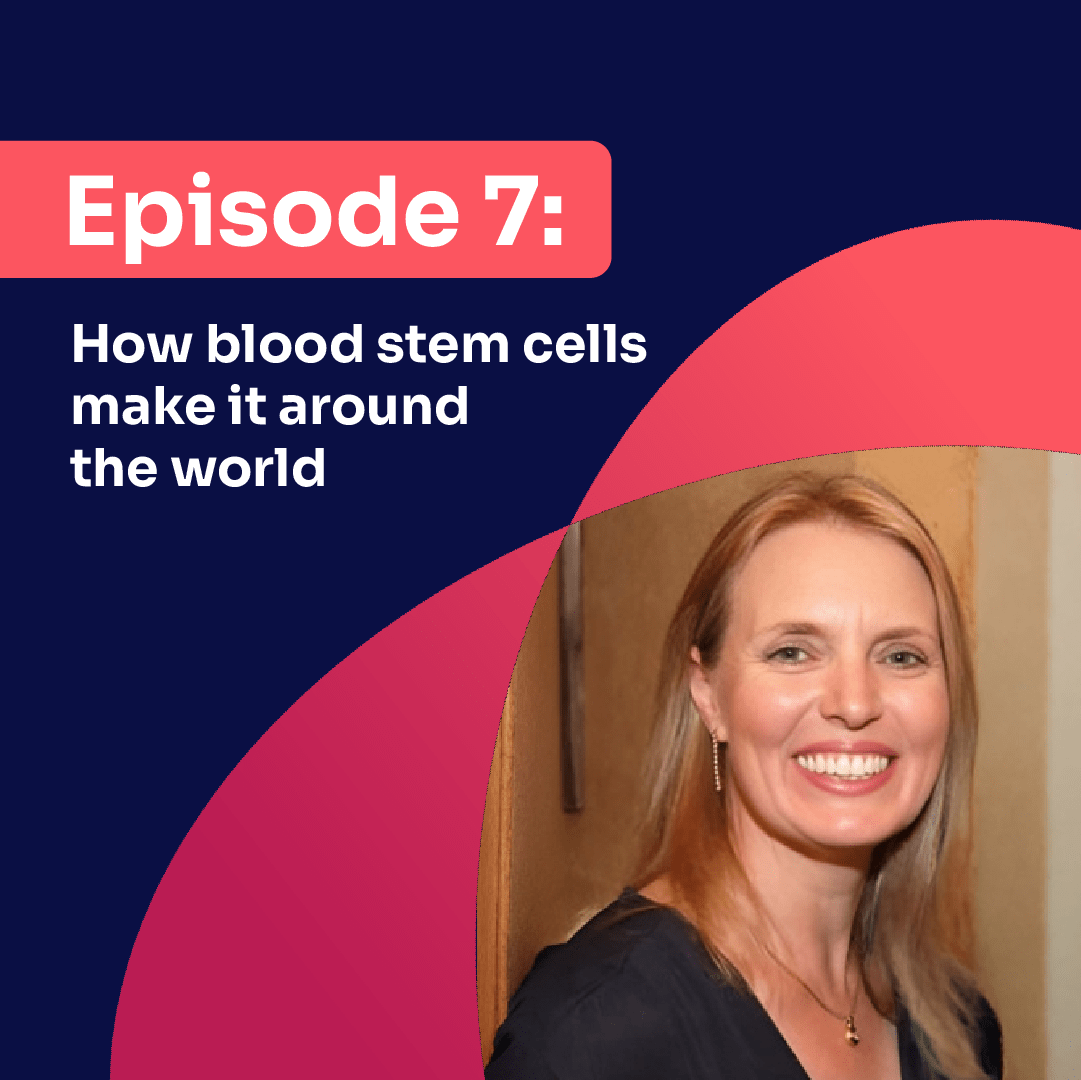
[00:00:02] Welcome to the Stem Cell Donors Australia podcast.
[00:00:12] Daniel: When we talk about stem cell donation, we often focus on the moment cells are collected. Today’s episode is about everything that has to happen before and after that moment. The searching, verifying, paperwork, logistics, international coordination and problem solving that make a transplant possible. Our guest today is Fiona Harris, National Search, Transplant and Registry Coordination Manager at Stem Cell Donors Australia. Fiona, welcome to the podcast.
[00:00:37] Fiona: Thanks, Dan. Very happy to be here.
[00:00:39] Daniel: Well, it’s good to have you here. It’s the first sort of time I think we’ve talked about NCU’s role and what you guys do in helping coordinate transplants across the world. It’s quite baffling some of the stories you’ve been able to share with us about that experience.
[00:00:52] Fiona: Yeah, it’s a really privileged position because we deal with a lot of people. So we look at Australian patients really are our focus and we’re looking for a match for them. So we could be looking internationally and domestically to find a match, but more often than not we’re finding a match internationally. All of a sudden we’re speaking with international registries who are in various countries around the world with different time zones and different languages. English obviously isn’t always their first language.
[00:01:16] Daniel: So for somebody who knows about the registry but who doesn’t know what happens behind the scenes, how would you explain your role in the organisation?
[00:01:24] Fiona: Yeah, so our focus as a team is on getting a stem cell transplant to the patient. So in simple terms, the role of the National Coordination Unit is to connect every step between identifying a potential donor to safely delivering those cells to a patient in need. Now most people think about the challenges finding a donor, but that’s only the beginning. Once a potential match is identified, there are countless moving parts to coordinate, you know, collection scheduling, donor testing, medical clearance, both the donor and the patient, transport arrangements and logistics, and then there’s communication difficulties because you’re speaking with international countries, English isn’t their first language and multiple time zones. Basically, our team acts as a central hub that keeps everything moving safely and on time.
[00:02:06] Daniel: So by now, hopefully many of our listeners will be familiar with the process of finding a blood stem cell donor match, whether or not it’s on the Australian registry or an overseas registry. So what actually happens from that point in actually getting those cells to a patient? Can you talk us through sort of the process?
[00:02:22] Fiona: Yeah, so you’re right Dan, a search may identify a couple of potential matches but a transplant only goes ahead when one of these donors successfully completes all the steps and they can then donate. So first up, the potential matched donor must be contactable. We must be able to reach them. So if that’s a valid email or a phone number, something that we can use to contact the donor. Step two would be actually once you’ve spoken to the donor, making sure that they’re willing to proceed. So they need to know who Stem Cell Donors Australia are, they need to know why we contacted them, and they need to know what we’re asking them to do. So that education piece is super important. And then almost it’s like the stars have to align because the donor must be available during the period that the transplant center requires a donation for the patient. So they can’t have any holidays booked. Hopefully they don’t have any university exams, there’s no family commitments and things like that. So it really is an alignment of stars.
Then you’ve got medical suitability. So, the donors must be medically suitable to donate. So it must be in the donor’s best interest to donate. So, they can’t have a health condition that’s just been diagnosed, a new or sudden illness, anything like that that would stop them from donating. And then we’ve got to talk about transport. So, you’ve got these cells, how do we get them to the transplant center and that could be next door. It could be across states around Australia or it could be from one country internationally back into Australia and vice versa. While all this is happening, the patient must be kept medically stable and ready to receive the transplant. So, there’s a lot of moving parts and they all have to fall into place and that’s what our team does.
[00:03:43] Daniel: Amazing. And you sort of touched on a point there that once this process starts happening, it’s very time critical. It’s very much you need to know that everything is going to happen within a certain period of time. Can you tell us why that timing is so critical for the patient? and in particular sort of once they’ve started conditioning.
[00:04:00] Fiona: Yeah. So patient conditioning is the intensive chemotherapy and or radiotherapy that prepares the patient to receive a transplant. So conditioning suppresses the patient’s own immune system so that they can accept the transplanted cells. Once patient conditioning has started, the patient is in a very vulnerable position with a weakened or no immune system. And so cells arriving on time as planned is critical to the survival of that patient. That’s why every milestone leading up to the collection and the of cells is carefully monitored and why contingency planning is such an important part of what the National Coordination Unit do.
[00:04:33] Daniel: And so what are some of those practical considerations that people might not really be aware of when it comes to transporting these cells, like you said, across country and across international borders?
[00:04:45] Fiona: I think people are often very surprised by how much planning goes into moving cells from one collection centre to the transplant hospital. So when the collection is finished, the cells are packaged into a validated shipper that will safely and securely hold the cells at the required temperature for the duration of the shipment. The shipper and the accompanying paperwork are handed over to a medical courier or a courier company and they begin their journey to the transplant hospital. So most transport is via a commercial flight either within Australia or to or from another country. And the cells require pre-arranged screening and uplift approval which confirms that the cells are life-saving and that they can’t be x-rayed due to the risk of cell loss. These approvals are presented to the airline security personnel so that the courier can board the plane. Cells are taken on the plane as hand luggage and actually kept within arm’s reach of the courier for the entire journey. If the cells are for an international patient, we have to apply to the TGA, which is Therapeutic Goods Administration, for an export permit prior to the collection, which allows the donated cells to be taken out of the country.
So there’s a lot of paperwork and regulations that have to be ticked off to get these cells out of the country or onto any plane. The other thing that’s interesting is that the National Coordination Unit notifies the airport when we are expecting couriers arriving in Australia with cells from international donors, and the airline staff actually sends a staff member to meet the courier at the gate when they get off the plane and escort the courier quickly through customs and security so that they can get to the transplant hospital as soon as possible. So we’ve had instances where a courier has landed in Sydney, and because of this escort service offered by the airport, we’ve actually had the courier get off the plane and then arrive at the transplant hospital half an hour for a local kids hospital. So that kind of time difference is just amazing. And again, it’s just that collaboration between all these different parties to get the patient the cells as soon as possible.
[00:06:25] Daniel: I feel it’s sort of like it’s a hot potato situation, isn’t it? Once you get those cells, it’s like we’re getting them as quickly as possible through this international network of organisations and people.
[00:06:37] Fiona: Yeah, and exactly. And everyone who’s travelled knows how you can get stuck in customs, how you can get stuck in security. And so if you’re having these life-saving cells and all of a sudden you’ve got an extra 2 hours onto your journey, it’s just something, if we can avoid it, it’s a really good thing.
[00:06:58] Daniel: And so what does happen if a sample is delayed, or if it’s held up, like you said, potentially at customs or at risk of missing a flight? What sort of contingencies are in place? I know you guys are often on the phone after hours as you alluded to, speaking different languages trying to get everything to align.
[00:07:08] Fiona: Yeah, and I think that’s a key bit. It’s just open communication. So we have, yes, we have an emergency number, so someone in the team is available 24 hours a day, seven days a week. And it’s just about having clear understanding that if there’s a problem, you need to contact us. Because of our relationships and obviously our team’s very big on building relationships and maintaining them through all the different organisations that we deal with, we’re able then to lean on other people and say, hey, I’ve got these cells stuck. What’s happened? How do I need to go about fixing this? Who do I need to call and how can we get this done? And fundamentally, the majority of the time when we say this is a life-saving treatment for a patient in need, everyone goes above and beyond to help us out and to get those cells released.
We’re the patient advocate, we’re trying to get these cells there. We know that there’s someone that desperately needs them and that there’s a lot of people, including the donor, that have given up a lot and donated a lot to get these cells, these patients. So it’s our journey, it’s our job at that time to help see it through,
[00:08:09] Daniel: Now I know there was a recent case you had where you had some blood stem cells come from an area of the world that’s quite volatile at the moment. Can you talk us through some of the challenges you had when you were dealing with that case?
[00:08:20] Fiona: We have one where we had Australian patient obviously in need and they were looking for a match and they only found two compatible donors both in Israel, which is fine, we deal with Israel quite a bit, but unfortunately this is right at the time that the Middle East conflict started. So the team had planned to, you know, they had no alternative for their patients. They planned to collect and to cryo preserve the cells on arrival at the transplant centre. So what that means is you’re transporting the cells fresh. So they’re collected and then transported straight with a medical courier to the transplant centre. But when they arrive there, they’re frozen. And what that does is buy the transplant centre some time. So it means that they don’t have to have started their patient on conditioning. So there’s no risk to the patient. And once the cells are securely at the transplant centre, then they’ll start the patient conditioning. And then when the patient is fully conditioned, then they can thaw the cells and then infuse.
So this is our contingency plan for Israel because and the ongoing fuel crisis which caused a whole lot of flight disruptions. And so during this time when we’re trying to arrange this, shipment plans were finalised and confirmed and we’ve got all the necessary approvals and then it would change. So this actually process changed four times during this collection. Then two days before the collection when the donor has already started their GCSF mobilisation, all commercial flights into Israel were stopped. So all of a sudden we actually can’t get a courier to come into Israel to collect those cells and so this now is panic. We have a donor who’s begun conditioning. So cancelling would be both clinically challenging and also potentially harmful for the donor. It’s an easier journey for the donor than just to donate those cells. So we had to work with the transplant hospital to look at our options, including can we ask Israel to freeze the cells or to cryopreserve the cells there? That unfortunately wasn’t an option. And so then we reached out to other contacts we have. So we had a different courier company that we don’t use that often who actually have couriers based in Israel. So all of a sudden that overcome the of getting someone into Israel because they had somebody there. But the problem was all outbound flights were fully booked. So we had to really negotiate with this company over basically a six hour period, bearing in mind that when I first phoned them, it was 2am in Israel when we needed this to happen and they were on the phone and they were trying to make this happen. So they were amazing for us. They managed to get the courier on a flight. It was a different route than we would normally take, but they got the cells to us. So it’s funny that you’re thinking all the time when you’re thinking about patients and donors and you’re thinking about the best donor, but all of a sudden then you’re impacted by geopolitical situations that just at the very last minute could put this transplant in jeopardy.
[00:10:48] Daniel: I mean, that’s the thing, isn’t it? The smallest sort of issue internationally, geopolitically or I suppose climate based as well, like it could be any number of challenges.
[00:10:56] Fiona: Yeah, and we’ve had known what we call them like natural disasters, but we’ve had numerous cases. I think probably the most recent case for us was an Australian patient who had finished basically almost at the end of their conditioning, the cells were collected in the US. and all of a sudden we’ve got a cyclone that hits the town where the collection centre is and flights were cancelled, airports closed and all the major roads were closed. And so at this time when the cyclone hit, we have a courier in transit.
So the donor’s donated, they’re halfway across the States and then their flight into Australia was cancelled. So we could see it happening and we could be on the front foot. So we had to rearrange the flights for the courier. We had to redirect them into a different city in Australia. Then the courier was met by one of our senior staff members. They grabbed a car and they started driving. And through a series of, they couldn’t take the normal roads because the roads are closed. They had to take inland roads. Then through our marketing team, they managed to get in touch with the Department of Health in that area who got in touch with the ambulance service who actually was able to meet them and then effectively frog hop the cells into the transplant center. So it was an amazing, again, collaboration between ministers of health, media, ambulance, and then just the usual courier stuff all trying to help to get cells for this patient. So that was a pretty amazing experience. It added on an additional 12-hour road trip that we didn’t foresee happening, but it only delayed the patient’s infusion by one day. So it was an amazing outcome with multiple agencies involved.
[00:12:19] Daniel: That’s really incredible. Yeah, I remember sort of sitting on the side and watching all that unfold and just going, wow, this is incredible.
[00:12:26] Fiona: Yeah, and the people that you speak to and everyone, like I said, everyone when they know its for someone and its going to be life-saving, everyone just does everything they can to help.
[00:12:34] Daniel: So obviously these sorts of situations, as you mentioned, there’s a lot of people both nationally and internationally, you work with this massive sort of network of transplant centres and couriers. How do you develop those relationships? I mean, I feel like it’s not something you just, you could wake up tomorrow and all of a sudden, you know, you know how to get cells from Israel to Melbourne.
[00:12:47] Fiona: Yeah, we’re super fortunate because in our role, we’re give and take. So sometimes we’re asking, you know, an international donor to help our patients, but then other times they’re asking for an Australian donor to help their patients. So we’re both in each others, you know, we have to work together. Most of our communication that we with these colleagues is via email. That’s how the majority of it happens. It just works better for a time zone and so we’re emailing. I think the key bits, like any kind of relationship that really bonds us, are times of crisis.
COVID was a huge example. When we hit the pandemic, everything that we did changed from the little bit that I’ve spoken about today. When you think about medical couriers having to transport cells directly, hanging onto cells and transport them across countries, none of that could happen through the pandemic because borders were shut, flights were down, there was no way. And so we had to rely on our international colleagues and we would be speaking to them at 2 in the morning and saying, how can we make this happen? How can we change our entire process? So those times of adversity where we’ve had to overcome things have really bonded us. I think that’s been amazing. We’ve had the opportunity as a team, various members to go to different international conferences. And so then you actually get to meet people face to face, which again, strengthens relationships. I think also it’s the common goal, irrespective of which country we’re from, we’re all working to provide cells for a patient in need. And so that common goal also aligns everybody.
[00:14:15] Daniel: So we were talking about a couple of specific cases earlier and I was sort of a little reluctant to mention exactly where in the world the donor came from. And I guess that’s because we are very concerned with donor and patient confidentiality during the donation process. Can you tell us a bit more about how you ensure that and why that’s important?
[00:14:34] Fiona: Yeah, sure. So, protecting privacy is sort of one of the fundamental responsibilities of the registry system, even down to we have two different staff teams. So we have one team that’s focused on donors and the other focused on patients. And so staff working on the donor side are deliberately kept separate to staff working on the patient side and information is shared strictly on a need-to-know basis. Identifying details are removed from routine communication and each patient is assigned a unique number and the same with a donor. The donor has a unique number as well. And so that’s how we refer to them in all our communication. So, our role is to make sure that the right information reaches the right people without compromising the privacy of either the patient or the donor. So that’s how we manage it.
Having said that though, once a donor has donated to a patient, they are able to write anonymous letters to each other. And so again, without sending any personal details, they’re allowed to write a letter. So typically we see patients and their families write letters saying that the hope that they have given them and that they can’t believe that someone would selflessly donate their stem cells for someone that they don’t know. Conversely, we have donors just sending letters of well-wishers, basically. We’ve had other donors who have just said, I was just at a bit of a loss with my life. I just thought I’d sign up just to see if I could help someone and I can’t believe the sense of purpose that it’s given me, knowing that I can do something that could actually impact someone else’s life in such a positive way. So they’re really beautiful things. Those letters come through my team, which is one of the privileges of our role. And we just basically make sure that there’s no identifying details in them.
After a two year period after the donation, there is the possibility of the patients and donors having direct contact. So the patient would have to reach out and say, look, I’m willing to provide my details and the donor would have to do the same thing. And if they both consented, then their contact details would be shared and then they could have direct contact with each other. So we have donors and patients that have been corresponding and connected for 10, 20 years after donation. So that’s a beautiful thing. I think just to put it out there, though, that it doesn’t always happen. You have donors who just say, look, I’m really happy to donate, and I’m glad that they got the cells, but I don’t want to know anymore. And the same with the patients, and you have to respect their right to that as well. Yeah, so that’s, yeah, it’s a really interesting part.
[00:16:46] Daniel: I think, yeah, it sort of brings it back around to what you were saying earlier when working with international teams, you know, we’re all in it for the same sort of goal, aren’t we? And it’s to get transplants to patients, and it’s lovely that that sort of overarching motivation sounds like it carries through to the communications that donor and patients may have one day down the track.
[00:17:06] Fiona: Yeah, correct.
[00:17:07] Daniel: Well, thank you so much for your time today, Fiona. This has been a really fascinating sort of peek behind the scenes around some of the things the organisation does that we don’t often discuss. I had one last question I wanted to leave here with. And that’s for somebody who’s on the registry, and has heard about this and now understands the importance of the timeline when it comes to donation. What can these donors do now to make things easier if they are ever contacted as a match for a patient?
[00:17:33] Fiona: I think the most important thing is to keep your contact details up to date. If the registry can’t reach you quickly, valuable time can be lost. It’s also helpful to respond promptly if contacted, even if you’re unsure if you want to proceed. So, keeping the registry informed about major health changes, staying engaged, reading the emails and the newsletters that come through helps ensure that if you are identified as a match, the process can move forward as efficiently as possible. And for many patients, having an available donor at the right time can make all the difference.
[00:18:02] Daniel: And I mean, I guess that’s the moral of the story, isn’t it?
[00:18:05] Fiona: Yeah.
[00:18:06] Daniel: All right, well, thanks so much again for your time today, Fiona. I really appreciate it.
[00:18:08] Fiona: Absolute pleasure.
[00:18:09] Daniel: Well leave you to get back to the important work that you’re doing.
[00:18:13] Fiona: Thanks, Dan.
Do you have a story to tell?
Every experience with stem cell donation and transplant is unique, and your story could help someone else on their journey.
Whether you’re a donor, a patient, or a family member, sharing your journey can raise awareness, challenge misconceptions, and show others what’s possible.
We’d love to hear from you.
Share Your Story