Episode 8: Two stem cell donors compare notes
In this episode, we meet Mitch and Hunter, two stem cell donors whose journeys began years apart but ended with the same unexpected phone call. Mitch waited almost twenty years after joining the registry before being identified as a match for a patient in need. Hunter waited little more than a year.
Together, they compare their experiences from the moment they learned they were a match through to donation day itself. They discuss the testing process, preparing for donation, receiving G-CSF injections, and what it was actually like to spend several hours donating stem cells.
Listen now to hear two donors compare notes on the experience of being chosen as a match and donating stem cells to a stranger in need.
Listen now:
 Listen on Spotify
 Listen on Apple Podcasts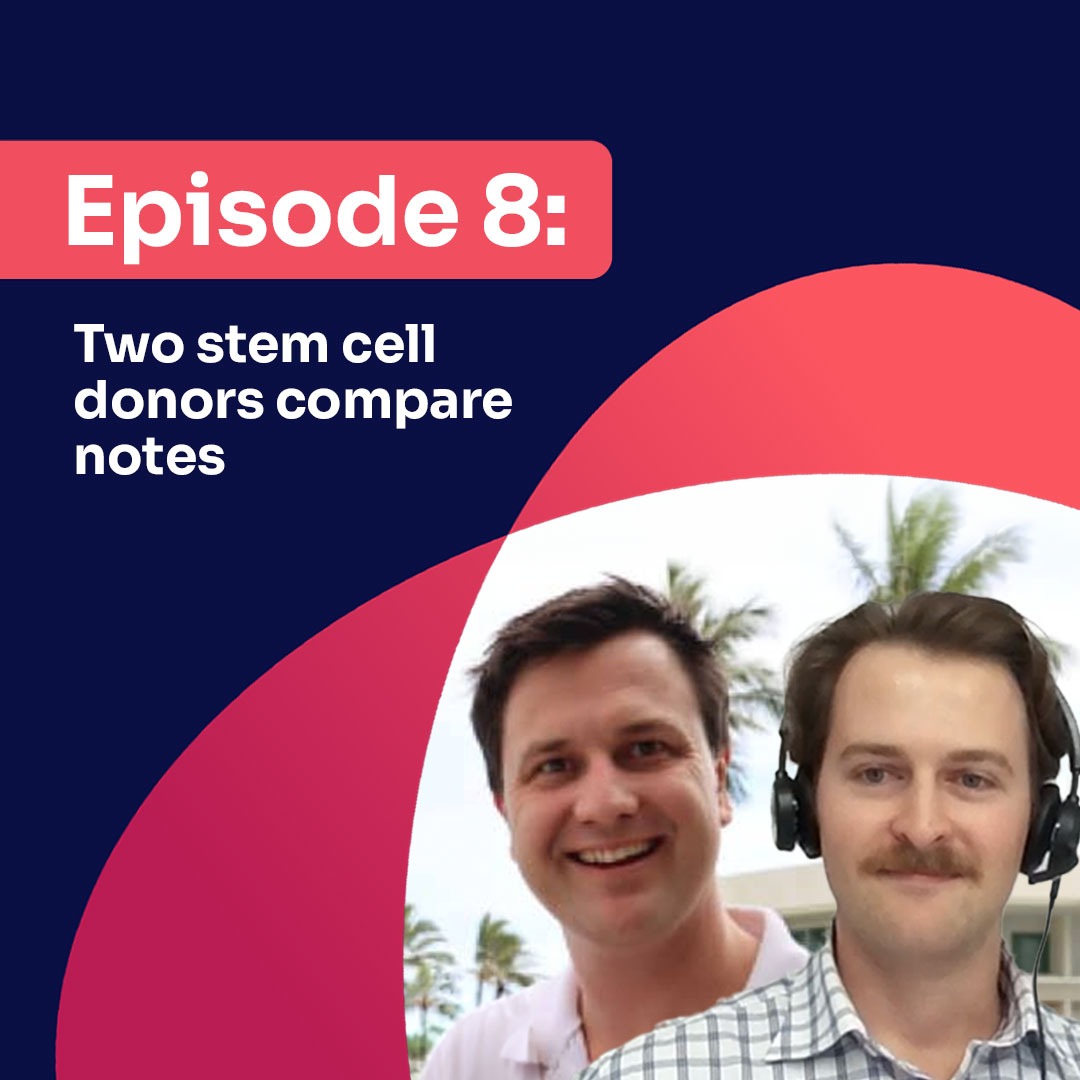
[00:00:02] Welcome to the Stem Cell Donors Australia podcast.
[00:00:12] Dan: This month, we’re joined by two people who have donated their stem cells to patients in need. Although their journeys began years apart, both eventually found themselves receiving the same unlikely phone call. In this episode, they compare notes on what happened next. Hunter, Mitch, thank you for joining us on the podcast.
[00:00:30] Mitch: Thanks, Dan. Good to be here.
[00:00:32] Hunter: Thanks Dan.
[00:00:33] Dan: Awesome. So let’s start off. Do you each want to introduce yourselves and tell us a bit about when you donated? Mitch?
[00:00:38] Mitch: Hey, I’m Mitch and I donated my stem cells back in August twenty twenty three.
[00:00:44] Dan: Awesome. And Hunter?
[00:00:45] Hunter: Hey, I’m Hunter and I donated my stem cells in September last year, twenty twenty five, so just on twelve months.
[00:00:53] Dan: Cool. So as I alluded to, you guys have a bit more in common than just donating blood stem cells. You know each other outside of the registry connection. Did you want to tell us a bit about that, Hunter?
[00:01:04] Hunter: Yeah, so my old man and Mitch used to work together and that’s how we sort of got linked in. I think Mitch can probably talk a bit more about it, I was too young to remember when he met me the first time.
[00:01:15] Dan: Right.
[00:01:16] Hunter: That’s sort of how we’ve linked in with each other.
[00:01:19] Mitch: So it’s funny, so I used to work for an investment bank and Hunter’s dad, John, worked at the same bank and I became really good friends with John. And back then John was a regular blood donor and plasma donor and I think he’s still doing it. Is that right? Hunter, up to his two hundred and fiftieth donation?
[00:01:37] Hunter: Yeah.
[00:01:38] Mitch: It’s insane. And he was always doing charity and, you know, trying to rally people to get together to raise money. And the first time I met Hunter was actually on a charity event. It was a kayak, wasn’t it? From, was it Sydney Harbor Bridge to Manly? You were just a young boy, mate. I think you’re about ten years old or something like that. And geez, you’ve grown quick. So yeah, so I’ve known Hunter now for a long time, but been very good friends with Hunter’s dad, John.
And it was funny, I haven’t seen John in years, but we’re at a pub the other week and went over and said, “Hey John,” and he was telling me about how proud he was of his son. He goes, “You remember Hunter?” I said, “I remember Hunter.” And he goes, “Well he just donated his stem cells and saved someone’s life.”
[00:02:18] Dan: And you’re like, hang on a second.
[00:02:19] Mitch: I was. I let him talk for a little bit. I didn’t say anything. And I was really, really happy for both Hunter and John. And then I told John, look, I’ve actually donated my stem cells as well a few years ago. And he said, “You’ve gotta get in contact with Hunter and try and make some cool content,” and that’s what today’s all about.
[00:02:38] Dan: Amazing. Small world, huh?
[00:02:39] Mitch: It sure is.
[00:02:40] Dan: So let’s go back to the beginning. When you guys first heard about the stem cell donor registry and signed up. Mitch, tell us about that. How long ago was that? So you donated in twenty twenty three. How long had you been on the registry before then?
[00:02:52] Mitch: We’re gonna have to go back a long, long way. It’s a short story, but it begins back in two thousand and three. Gee hunter, that’s probably almost before you were born, mate.
[00:03:02] Hunter: I was very little then.
[00:03:05] Mitch: So how my journey began was it was a Sunday afternoon. I was sitting down on the couch and an episode of Australian Story came on and it was a story about a young couple with their two year old daughter who was just about to pass away. She was struggling with leukaemia. She was just about to pass away unless they could find her a stem cell or a bone marrow match. And it really was a plea for people to go and join the registry. A very emotional story and I made the commitment, whatever it took, that night that I’m gonna go in and sign up to the registry and be on the list.
And I did. Back then it wasn’t so much stem cells, it was bone marrow. And I think technology’s improved since then. For some reason I thought, all right, I’ve signed up, I’m gonna get a call like next week.
And one week went to one month. I’m like, why haven’t they called? And then one month went to a year. I’m like, surely I’m still on the registry. And then, gee, twenty years later I got a call out of the blue from Stem Cell Donors Australia and they said, “Do you remember back in twenty twenty when you signed up?” And it was just such an emotional call. I’m like, how could I forget?
So that’s my experience in joining the registry. How about you, Hunter? Why did you do it?
[00:04:12] Hunter: Yeah, so I sort of followed in the footsteps of my dad. So he has donated blood and plasma for a really long time and I jumped on that as soon as I was sixteen, back when sixteen year olds could donate blood.
And Lifeblood was doing a bit of a drive around getting people who donate blood to sign up for the stem cell registry as well. So that’s sort of how I got involved. It was one extra vial that they took when I went in for my regular donation and I just sat on the registry. It was probably a bit of a different story to what you had, Mitch. I think I joined maybe in twenty twenty three or four.
[00:04:50] Dan: Yeah.
[00:04:50] Hunter: I got called out sort of, I don’t know, early twenty twenty five and I was in the chair donating by mid to late twenty twenty six.
[00:04:58] Mitch: It’s a surreal experience, isn’t it? Because once you make the commitment to join the registry, it’s like you’re hanging out for the call, you want it.
[00:05:06] Dan: Mm.
[00:05:06] Mitch: And then when you get it, it feels like you’ve, I don’t know, in a weird way, it feels like you’ve won the lottery, right? The jackpot and shit gets real, so to speak.
[00:05:14] Hunter: Yeah.
[00:05:15] Mitch: I mean, I’m kinda jealous that it happened so quickly for you, Hunter. That’s awesome.
[00:05:20] Hunter: Yeah, it was surreal knowing that the whole process, and I’m sure we’ll go into it a bit further as we chat, but the whole process is so unique and the matching process is so… you know, you have to be the right fit exactly for the person receiving the stem cells and that’s a pretty magical thing.
[00:05:39] Dan: Exactly, yeah. We say around one in fifteen hundred people on the registry will ever be asked to go on to donation each year. So it’s really cool that we’ve got sort of both ends of the spectrum as well because it is, as you alluded to Mitch, it can be really tough to keep people encouraged and engaged with the registry when, for example, in your case, it was twenty years until you finally got that call.
We always try and say, you know, it may not come tomorrow, it may not come next week, next month, next year, but it is a reality.
[00:06:05] Mitch: A thought that I often have is, and we’ll talk about my recipient a little bit more, his name’s Mark over in the UK. I joined the list well before he was sick. When I joined, he was fighting fit, still at work, not a problem in the world. And I just think that’s an important consideration. The life you might be saving, they might be fighting fit at the moment.
[00:06:29] Dan: Hundred percent. That’s a really good point. So let’s go back to, so you guys are on the registry, Mitch you’ve been on the registry for twenty years, Hunter, maybe about a year. You got that first call from the donor support team. Tell us about that. What did you think when you got the call? Did you know what was gonna happen? How did that sort of unfold, Hunter?
[00:06:45] Hunter: Yeah, I was excited and I jumped on it straight away. I got the call when I was at work and I sort of went up to my manager at the time and he said that, you know, it sort of this disinformation around the process with donating stem cells that I think still exists, you know, they’re gonna take it out of your spine, it’s gonna be really painful and knock you down for a week or two.
Which I think is so different to how I actually experienced it and that’s part of why I want to share my story because the process couldn’t have been any different to how I would have guessed how it would have gone. So yeah, it was excitement, a bit of nerves, but yeah, really was keen to help.
[00:07:23] Dan: And how about you, Mitch? What did you think when you got that call finally?
[00:07:26] Mitch: So like I… it was well off my radar, right?
[00:07:30] Dan: Mm.
[00:07:30] Mitch: I wasn’t thinking about it. And I remember I got the call in the depths of winter. It was like June twenty twenty three, about six, seven o’clock at night, it was pouring down with rain, I was already in a bad mood and I was taking the rubbish out to the bins, which is you know, I was getting wet and I got a call. Phone was going off in my pocket and the lady’s name was Stacy. And this is back when you were called Strength to Give.
[00:07:53] Dan: Yes.
[00:07:53] Mitch: Before you’d updated your name. And she goes, “It’s Stacy from Strength to Give.” And I thought that she was trying to ask me for money. And I was just about to say, “I don’t have any money and hang up.” She goes, “Wait, wait, wait. Do you remember when you joined the Stem Cell Registry 20 years ago?”
And it was that moment, it all just hit me. And it’s just so many emotions. And I was just like overwhelmed. I’m like, “I do.” And it’s just I felt like relief and I felt excitement. And she goes, “Would you still consider donating? Because you’re, she said, ‘You’re a match. Would you still consider donating?’”
And I didn’t know about stem cells. I thought I was signing up for bone marrow, which is a bit more of an invasive procedure. And I said, “Here’s the thing, Stacy, my situation’s changed. When I joined the list when I was twenty years old, I didn’t have a family, but now I’ve got a wife or I’ve got a one year old boy, a two year old boy, and I I’m gonna have to go and clear this with the missus.” And she said, “Yeah, no problem. Like there’s no pressure. Just get back to me if you want.” And I went inside and I told the same story to my wife and she goes, “Like if this is what you want to do, go for it.” And I called her back. I said, “Stacey, I’m in.” And she said, “Well don’t get too excited just yet. You’re just a match. You’ve got to go in for some follow ups and they’ll let you know.”
So to answer your question, the feeling was absolute excitement. It was the best feeling and I want to do it again.
[00:09:07] Dan: We hear that a lot from donors. When can I do it again? So you both alluded to the fact that traditionally we’ve often talked about stem cell donation in terms of bone marrow and that operation going in, getting the needle in your thigh. So were there any other sort of misconceptions or things that you were sort of concerned about at that first point of contact?
[00:09:25] Hunter: Like I think the bone marrow donation is quite different to the way that stem cell transplants get done, at least how my experience was, and the ease of doing it. You know, I donate blood so I’m used to having needles and that sort of stuff in my arm, but this was just a much easier process because I’m sitting in a much comfier chair with cannulas in my arm and I can move around a little bit and have that comfort.
So the misconception around that bone marrow transplant initially was certainly something that I took a moment to think about, but in reality it wasn’t a problem at all.
[00:10:00] Mitch: Yeah, I was mentally prepared to donate my bone marrow and when Stacy told me that technology has improved over the past twenty years, the odds are like there’s a nine in ten chance that I’ll just be donating stem cells.
I said, “Well what does that involve?” She’s like, “Basically it’s just like giving blood.” I said, “Is that it? Like nothing. Sure, sign me up, let’s go.”
[00:10:21] Dan: Yeah, right. So obviously, yeah, the donation day itself is very much like that, but there is some preparation that you sort of need to do leading up to that. We’ll get into that shortly. Let’s go back. So you got that first call and you sort of done your health questionnaire, they said you’re a match. One thing to clarify is while you are a potential donor at that point, you are a match for a patient. So each patient may only have eight or ten people in the entire world who are genetically matched with them. So you’re already on a very unique list at that point.
So talk us through the testing and stuff in the lead up to donations. Obviously, first of all, you went and got a blood sample and then perhaps needed to wait a little while. Hunter, how long did you wait between sort of that initial blood test and finding out you were the main donor?
[00:11:04] Hunter: Yeah, I was trying to reflect on this whilst I was thinking about this session. I think it was something in the order of a month or two where I was, I went in, gave the extra bloods ’cause it was part of my normal donation, so they took some extra blood samples out so that they could test the match. And then yeah, it was sort of sitting and waiting, probably for that month or two months, I reckon, whilst the doctors and the medical teams were working out if it was the right fit for the patient.
[00:11:29] Dan: How about Mitch? You’d been waiting twenty years by that point, so a couple of extra months wouldn’t have been much, right?
[00:11:34] Mitch: Yeah, it was a similar experience to Hunter. I think it was five or six weeks, you just go in, do the questionnaire. You meet with some fancy doctors who all have big names and then you wait and they call you and say you’re either, you know, the perfect match or the best match or you’re not, and in my case I was. So the process was yeah, really, really quick.
[00:11:53] Dan: Hm. So Mitch you alluded to obviously once you got the call and you had to speak to the wife.
[00:11:58] Mitch: Well yeah, for sure. Like it was kind of a joint decision. It is her blessing is what I wanted. And you know, once I explained to her the process, it was a no brainer.
[00:12:10] Dan: And how did your other family and friends respond when you told them? You know, did many of them know what this was all about? How much did you have to explain?
[00:12:18] Mitch: I remember telling Mum and she thought like one of my limbs or organs were gonna be cut out or something. She’s like, “Ooh, I… are you sure you wanna do that?”
[00:12:25] Hunter: Yeah.
[00:12:25] Mitch: I’m like, “Yeah, mum, like I’m gonna literally save someone’s life.” She’s like… and then I like it was just a bit of education, right?
[00:12:33] Dan: Yeah.
[00:12:33] Mitch: and after I gave her that education, she was one hundred percent on board and proud of me. So yeah, that was the initial reaction.
[00:12:41] Dan: Mm. And what about you, Hunter? You were saying your dad’s been a long time blood donor, so I imagine he’s more familiar with the process.
[00:12:47] Hunter: Yeah, familiar but also still didn’t know a lot about the process and what stem cells were and how magical they can be to the recipient. So it was a lot of that education piece as well. I spoke to my fiance about it and to my mum and my dad and sort of got them on board and I sort of alluded to the fact that I’d need at least one of them to help me on the day, you know, drop me off and pick me up when I was donating and that sort of thing and yeah.
There were things that I had to teach them about, but by and large, it was pretty simple. And, you know, I get strange looks sometimes when I say I donate blood and, you know, as a twenty-six year old, I’ve done it over a hundred times. And it’s the same sort of thing sometimes when I’d have spoken about my stem cell donation journey, because it’s that same thing as that selflessness. You know, my approach is that you don’t know when you or a loved one close to you will need the generosity of some stranger out there.
And I think it’s just a really good way to give back.
[00:13:44] Dan: Well that’s a great way to look at it. Okay, so let’s fast forward a little bit. We’ve waited the month or two and you’re both ready to donate via apheresis. There is some preparation in the days leading up to the actual donation you need to do at home. Hunter, do you want to talk us through that? The G-CSF injections that you need to do. How did you feel about that? Obviously being a blood donor, you’re probably familiar with needles, but was there any sort of hesitancy? Did you do them yourself? Did you get your partner or somebody else to do them for you?
[00:14:10] Hunter: Yeah, I was pretty keen on the process until the point where I was working out what this G-CSF stuff is and it was a whole learning process, you know, working out what it does and how it sort of changes things in my body to get me prepared for that donation. I think it was about a week out that I went to the hospital to Saint Vincent’s and did a final checkup and I was given the G-CSF injections and then they said, you know, a few days out, I think it’s three days before you’re gonna start injecting yourself, a couple of times a day.
And I was like, okay, cool, sweet. You know, they’re in these very sort of plain boxes and you don’t know what they look like. The first time I pulled one of the G-CSF needles out, it was like, this is actually something proper full on needle going into me kind of thing. And one of my fiance’s friends is a nurse and I was like, maybe I should ask her to come and give me a hand the first time, just, you know, so I’m doing it right. I didn’t end up getting her to help, but it was a pretty simple process, you know.
Pretty pain free. That sort of needle injecting technology is used by other medications and other people, you know, inject themselves in that same way to give themselves insulin and other medications. So it’s a really safe thing. The injection is painless virtually. I did get some of those sort of body aches on the last day or two when I was injecting myself with the G-CSF, but you know, you have Panadol and that sort of stuff to help you get through it if you need it. I didn’t really need it, but yeah, didn’t really feel like I was doing that much.
[00:15:44] Dan: I guess in context of what you’re ultimately donating, it’s sort of a small ask, isn’t it, to do the injections for a few days leading up?
[00:15:52] Hunter: Yeah. One of the questions I had for the medical team was, is there any benefits of having more stem cells running around my body in the lead up to it? Which I thought in reflection it’s probably a bit of a funny question to ask. But I think the side effects piece, you know, when they mentioned that you might have pain on your spine as the stem cells are flowing out and that sort of thing, it was like a really straightforward process and no side effects apart from what was explained to me before.
[00:16:19] Dan: And yeah, so that’s the thing with the G-CSF injections. When you do feel that muscle pain in those last sort of day or two before donation, that actually means it’s working, you know, so your blood is getting filled with stem cells. For anyone listening at home who doesn’t know, G-CSF injections, basically they’re administered in the three to four days leading up to donation. What they basically do is they pull the blood stem cells out of your bone marrow and into your blood so that when you actually go into the hospital to donate, the apheresis machine can filter those stem cells out of your blood, take them to the patient who gets transplanted with them and then you get the blood back and you know you’re good to go. So Mitch, tell us about your experience. Had you ever done self-administered injections before? Was there any sort of concerns around doing those?
[00:17:01] Mitch: No, there wasn’t, and I think the whole process was a bit of a non-event, to be honest. It was a tiny jab, as Hunter said, it’s almost painless. I felt some sort of mild side effects after kind of like a bit of a cold.
[00:17:14] Dan: Hmm.
[00:17:14] Mitch: Day one nothing, day two a little bit coldy. Day three, it’s just kind of felt like I had a cold. Yeah, just a few panodol and I was fine. I mean, just nothing you can’t get through, right? It’s a piece of cake. So bit of a non-event to be completely hnoest. I was just pumped, pumped that I’m gonna go in and save someone’s life. I was so excited. Like it’s just… the trade-off is nothing.
[00:17:35] Dan: Yeah, you’re right. In the context of the broader experience, it’s great that you’ve both been so sort of nonplussed about the injections. Because it is one thing that some donors can be a bit wary about. So we’re up to donation day now. You’re going into the hospital, you’re going onto the apheresis machine for about sort of five to seven hours. Tell us about that. What do you remember most clearly from that day? And what did you do to amuse yourself while you were sitting in the chair, Mitch?
[00:18:00] Mitch: So I went by myself, didn’t take my wife, and my donation was at Royal North Shore Hospital. And it was a couple of years ago now, but what I remember was the staff. The nurses were hilarious. There was one funny lady with crazy blue hair and she just cracked the most funny, inappropriate jokes the whole time and I was just laughing. So that’s what I remember.
It honestly, if you’ve ever donated blood, it’s just like donating, literally just like donating blood except instead of one needle in the arm, you got two. And they hook you up with amazing food and you get to talk to other people and you basically just get treated like a king. And the whole thing just flew by. I think I was only in the chair for like four hours or something and they’re like, “Yeah, you’re done.” I’m like, “Is that it? You can go home now?” And I literally just… my wife picked me up and I jumped in the car. Look, I felt a little bit tired after it. Just a lot of emotions running through the body and so I just went to bed early and honestly the next day I felt almost back to normal. Day two, I was back to normal.
So yeah, walk in the park.
[00:19:00] Dan: Mm. And how about you, Hunter? What was the donation day like and how was that recovery?
[00:19:05] Hunter: Yeah, it was almost exactly the same as Mitch. So I donated at St Vincent’s Hospital in Sydney and yeah, it was pretty easy. You rock up in the morning, you’re down in the Kinghorn Cancer Centre there at St Vincent’s and all the staff are really, really nice. The nurses that are sort of helping get you settled into the chair and getting you hooked up to the machine. Really simple.
I think I probably yeah, between three and four hours total donation time as well. So the time flew by. I think comparing it to blood donation where you have needles in your arm and that sort of thing it’s a lot more of a comfortable experience. I must say, donating, even though you’re in the chair for a long time, you know, it’s a pretty easy process.
[00:19:51] Mitch: you get treated like a rock star all day, it’s kinda like you’re like a unicorn or something. It’s… I don’t know, they mustn’t get too many donors come through. It’s like, “This is Mitch, our stem cell donor.”
[00:20:04] Hunter: Yeah.
[00:20:04] Mitch: and yeah, I want that feeling again.
[00:20:09] Hunter: And like the day or two after you feel a bit drained, but I think I was back in the gym within two days sort of thing, you know, feeling back to myself. So it was yeah, such an easy process all up.
[00:20:20] Mitch: Yeah, you might be physically drained a little bit, but you’re like on the biggest high, and that high for me, it lasted weeks. It lasted forever.
[00:20:30] Dan: Yeah. So obviously your experiences were incredibly positive and you only had a day or two to recover afterwards. We shouldn’t understate that. It can sometimes be a little longer, three, four days. But ultimately it’s more just sort of muscle aches and that sort of thing, right? ‘Cause you have effectively given like a really significant gift to the patient.
[00:20:47] Mitch: What I found, Dan, another memory from that day was I knew that my recipient was a man in the UK. That’s all I knew. But somebody flew out from Germany to pick up my stem cells and they were waiting live. I’m like, this stuff must be pretty precious. If they’ve got some bloke who’s flown all the way out to Germany to hand deliver them to the UK to go in live, like not frozen obviously, live. And I found that pretty cool.
[00:21:14] Dan: Yeah, a hundred percent. So last month we actually spoke with Fiona, who works in the National Coordination Unit at Stem Cell Donors Australia, and she was telling us some of the stories of the couriers that traverse the world delivering stem cells. It’s quite remarkable some of the journeys they go on to get to the patient. And for it to be a live product, you know, to go from Australia over to the UK and be infused into a patient. It’s quite a remarkable journey, isn’t it?
[00:21:38] Mitch: Apparently there was a bit of a hold up with my courier, they got stuck in Dubai and we had Mark the recipient literally waiting in a hospital in the UK and they’re like, “We’re gonna get him on another plane and we’re gonna get him here.” It’s a bit of a kerfuffle.
[00:21:53] Dan: So since your donations, have you guys approached any of your friends and family and encouraged them to join the registry? Obviously being on the podcast, you want to sort of spread the word more widely. Have you had any conversations with friends and family about joining up? Got anybody else to join up, Hunter?
[00:22:09] Hunter: Yeah, I sort of have. I’ve got friends and family that are really in that target age where you want people to be signing up for it, you know, those sort of young adult ages. And I think the way that people can sign up now with the much more streamlined cheek swabs and that sort of thing makes it a whole lot easier for people too. I’m trying to get something off the ground as well at work where I’m trying to promote that to colleagues and that sort of thing as well. So there’s a bit happening.
[00:22:36] Dan: That’s awesome. And what about you, Mitch?
[00:22:38] Mitch: So I’m forty. I like you know, I signed up on the registry when I was twenty, but I’m now forty one. I don’t know that many people under thirty, to be honest with you. So it’s like I feel like the best use of my time or how I can encourage more people is to help create content with you and so you can use that on social media and whatnot and get the word out. So that’s the approach and hence why I’m here today.
[00:23:00] Dan: So what would you say to somebody who just found out about the stem cell donor registry and was considering signing up?
[00:23:06] Mitch: I think everyone knows the answer, right? Just do it.
[00:23:09] Hunter: Yeah.
[00:23:10] Mitch: Just do it. The risk to reward, it’s how did I frame… I did a talk once in town. I got invited to do a talk about it. And the way I sort of framed it is I work in financial services and the return on investment that I got out of this, it was asymmetric. If you think about it, like what did it cost me? Nothing. Like not one cent from a financial point of view. Time?
Well, you know, a couple of days when you consider going in for the health checks and the actual procedure and the recovery. So that was the investment. No money, a little bit of time, but the reward, it’s astronomical, like the feeling that you get. But I’ve actually made a really good friend out of it, a friend for life. I talk to my recipient, Mark, his name is, every week and only yesterday he just had his three year anniversary since the donation. So yeah, it’s a no brainer for me.
[00:24:01] Dan: What about you, Hunter? What would be your pitch to somebody who is listening to this even and thinking about joining the stem cell donor registry?
[00:24:08] Hunter: Yeah, I think it’s pretty magical the whole idea that there is some part of you floating around in keeping someone else, you know, giving them an opportunity to keep on living and having an awesome life. It’s a stress free, painless process. As Mitch said, it takes a couple of days out of your time, but it’s really rewarding, really well worth it. And as I said before, like no one ever knows if they’re going to need stem cells in their life.
But you can pay it forward and join the registry and if you get that call, go through the tests and be open to doing the whole donation process.
[00:24:44] Dan: And you might just save a life.
[00:24:45] Hunter: That’s it.
[00:24:46] Dan: So thank you again, both of you, for joining us today. It’s been great to listen to two donors compare notes on their experiences. Like I said, it’s a unique perspective. Was there anything else you wanted to close with? Any other thoughts or anything you wanted to share, Hunter?
[00:25:00] Hunter: I think it’s just a shout out to Stem Cell Donors and the team at St Vincent’s that were there throughout the whole journey of my donation. You know, the work that you guys do and the work that all the hospitals that do these donations do is magical, it’s life giving and yeah, it’s something that we all need to recognise and celebrate.
[00:25:20] Dan: Hundred percent, can’t say enough kind words about the staff at the hospitals and the transplant centres. They’re incredible. What about you, Mitch? Any final thoughts?
[00:25:27] Mitch: My final thoughts is to anyone considering joining, I mean, just do it. You’ve literally got nothing to lose and everything to gain. And I’m extremely passionate about your organization ’cause it was just such a smooth process for me and I’ve gained a new best friend out of it and I’m actually planning to meet my recipient next year. It’s an amazing outcome. I want to do it again and I want others, I want others to go through the same experience because it was the best thing I’ve ever done.
[00:25:57] Dan: That’s amazing. If you go to visit your recipient next year, hopefully you’ll bring us along.
[00:26:02] Mitch: Mate, sounds good. If not, I’ll shoot some content.
[00:26:05] Dan: Sounds good. Thank you again both for joining us today, Hunter and Mitch. It’s been a pleasure.
[00:26:09] Mitch: Good on you, Dan. Thanks.
[00:26:10] Hunter: Yeah, cheers.
Do you have a story to tell?
Every experience with stem cell donation and transplant is unique, and your story could help someone else on their journey.
Whether you’re a donor, a patient, or a family member, sharing your journey can raise awareness, challenge misconceptions, and show others what’s possible.
We’d love to hear from you.
Share Your Story