17-year-olds can now register as stem cell donors in Australia
Seventeen-year-olds across Australia can now take an important first step towards becoming a stem cell donor, with the national registry opening registration to people aged 17 for the first time.
The change addresses a long-standing challenge in stem cell donation: younger donors lead to better outcomes for patients. As transplant approaches evolve and Australia increasingly uses mismatched donors to treat people with blood cancer and blood disorders, having more young donors on the registry has never been more important.
“Younger donors are associated with better transplant outcomes, particularly in complex or mismatched transplants,” said Lisa Smith, CEO of Stem Cell Donors Australia. “By welcoming 17-year-olds onto the registry, we’re strengthening the donor pool and giving patients a better chance of finding the right match.”
Meeting young people where they are
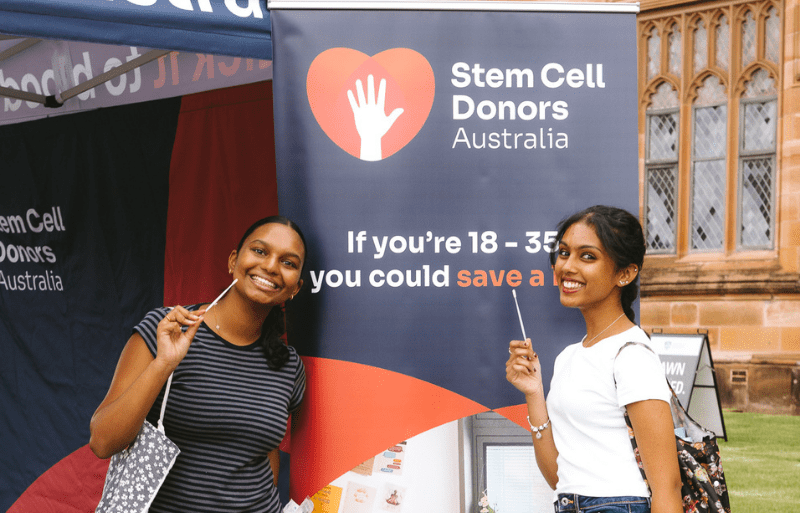
Through recruitment events at universities and secondary schools, the registry regularly meets 17-year-olds who are eager to register and frustrated they have to wait.
Until now, many of these young people were turned away, despite being highly motivated and close to the ideal donor age.
“That enthusiasm matters,” Lisa said. “This change means young people who want to help can take meaningful action now, rather than waiting and potentially never coming back to register.”
How it works
From age 17, eligible young people can now join the registry using a simple at-home swab kit.
Once a 17-year-old completes their swab and returns it:
- Their tissue type is added to the registry
- They become searchable in the patient matching system
- They can be identified as a match for a patient in need
Importantly, while matching can occur at age 17, the donation process itself cannot begin until the donor has turned 18. This ensures all donation-related steps align with medical requirements.
“The value of this change is that we can bring donors into the registry earlier,” Lisa explained. “Matches can be identified while someone is still 17, and preparations can be made so that if they are the best match for a patient, no time is lost once they turn 18.”
In stem cell donation, timing matters. Earlier matching can make a critical difference for patients who may be waiting urgently for a transplant.
A stronger (and younger) donor pool for the future
Stem cell donation is part of a broader, community-led effort to give patients the best possible chance of survival. By lowering the registration age, the registry is building a stronger, younger donor pool that reflects the future of Australia.
“Young donors don’t save lives alone,” Lisa said. “They become part of a national and global community working together so that every person who needs a stem cell transplant has the best possible chance of finding a match.”
With the support of their families and communities, 17-year-olds can now play a meaningful role in that shared effort.
For parents and guardians
Deciding to join the registry is an important step, and for many 17-year-olds, it’s one they’ll want to talk through with their parents or guardians.
Registering at 17 is safe and simple. It involves completing a swab kit at home to join the registry, and no medical procedures are involved at this stage.
If they register and are identified as a match for a patient, but are still 17, the donation process would only begin once they turn 18, with full medical oversight and informed consent.
We encourage families to learn more together, ask questions, and feel confident about what joining the registry means, both now and in the future.
Learn more and register
Registration at 17 is available via swab kits only. Eligible young people are encouraged to learn more, talk it through with their family, and take the first step when they’re ready.
To find out more about stem cell donation, including who can join the registry and what the donation process involves, visit:
- Learn about stem cell donation:
https://stemcelldonors.org.au/why-you-matter/why-donate/ - Check your eligibility and register:
https://stemcelldonors.org.au/join-the-registry/cheek-swab/ - Learn how donation works and what happens next if you’re matched:
https://stemcelldonors.org.au/the-donation-process/